Nasser Ishtayeh Associated Press
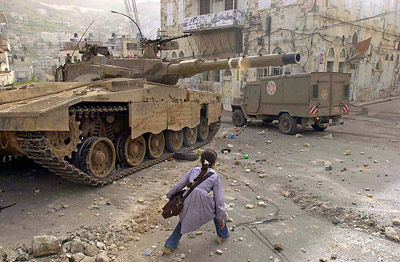
“The Way to School” A Palestinian schoolgirl walks carefully past an Israeli tank during clashes near her school in the West Bank town of Nablus, April 19, 2003.
The right to education is all to often taken for granted, while we often complain about our child's curriculum and the lack of resources in school, we seldom worry about our child walking through a true war zone on the way to school. Yet every day children around the globe are left to literally fight their way to school, risking their safety and lives for an education…for a chance at a future. Schools, students and teachers are increasingly under attack leaving children even more vulnerable to the effects of war. Low literacy rates heavily impact development and poverty, while also leaving children at increased risk of violence.
According to UNICEF, the 52nd session of the Commission on the Status of Women, which took place last month, approximately 93 million school-age children are not receiving an education, most of which are girls. The majority of the worlds children out of school are children living in conflict zones. According to the UNESCO special report issued in November 2007, Education Under Attack , 40% of the estimated 77 million children not in school are from conflict ridden countries. The worst-affected countries in the survey period from 1997 to 2007 were Afghanistan, Colombia, Iraq, Nepal, the Palestinian Territory, Thailand and Zimbabwe, according to data based on incidents reported by the media and ministries of education worldwide. Education is also directly related to empowerment, and more than half of those children out of school in conflict zones are girls.
According to UNESCO in the report 2008 Education for All Global Monitoring Report: Education for All by 2015. Will We Make It?, the number of children in school has increased in the last decade. The report refers to the achievement of the Millennium Development Goals, and additionally the Education for All Declaration. According to the report primary school enrollment rose from 647 million to 688 million worldwide between 1999 and 2005. However the report also stated that the “gender parity goal has been missed”, and that “gender equality remains elusive”.
One should also note that adult literacy rates dramatically impact the lives of children in multiple ways, including placing children and families at increased risk for human trafficking and enslavement. A mothers education and literacy has a direct impact on a child's education and literacy, thus it is essential that when looking into education and literacy we do not fail to see that adults as well as children are included in development programs. According to UNESCO , 774 million adults lack basic literacy skills worldwide, and some 64% of which are women.
It is clear that there is much that needs to be done to ensure that all of the worlds children receive a basic education, and that considerable attention needs to be placed on those children in conflict zones. While much progress has been made in recent years, it is still unacceptable that some 93 million children are without access to an education. If we are to see progress and hope for this and future generations of children, than we must place education for all as a top priority as it is the gateway to peace and prosperity.
