
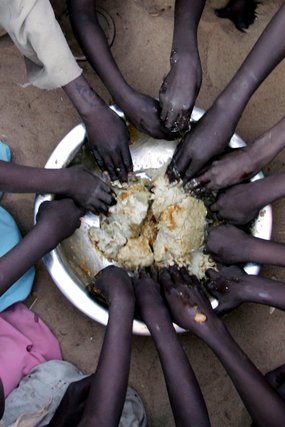
 News of the global food crisis is increasingly inescapable and as the price of food continues to skyrocket around the world, those most effected are women and children. Those children who are already most vulnerable are now placed in even more danger as the food crisis continues without any visible signs of curtailing.
What is the food crisis? Are the figures really so detrimental? Globally, rice prices have more than doubled over the last year and wheat prices have risen more than 130%. Therefore at each food staple percentage point of increase, the number of persons affected by will increase by 16 million, thus leaving some 1.2 billion people chronically hungry by 2025, according to UNICEF.
Malnutrition itself is dangerous as it increases the risk of disease and early death, for example protein-energy malnutrition, is a leading cause in half of all under-five deaths in developing countries according to the World Health Organization (WHO). Severe forms of malnutrition include marasmus (chronic wasting of fat, muscle and other tissues); cretinism and irreversible brain damage due to iodine deficiency; and blindness and increased risk of infection and death from vitamin A deficiency. Malnutrition also increases the likelihood of one acquiring various infectious diseases and result in the inability to recover from such infectious diseases.
Even mild malnutrition, when combined with other diseases, can lead to death. Malnutrition is implicated in more than half of all child deaths worldwide, and thus the pending malnutrition of millions more children must be deemed as a large scale international humanitarian crisis, as the stability of many countries teeters in the balance. While many countries are scampering for new food sources amid the rising prices of rice, it is the children who are suffering most. Children are not just suffering from malnutrition, but also a lack of education, as many families are pulling children from schools, due to the inability to pay for school fees. Other families are keeping children out of school and placing them into the labor market to supplement the families income.
While the food crisis may seem like a distant cry, it is truly an emergency of immense magnitude, so much so that the World Food Program (WFP) is calling it a “silent tsunami.”
Related news:
