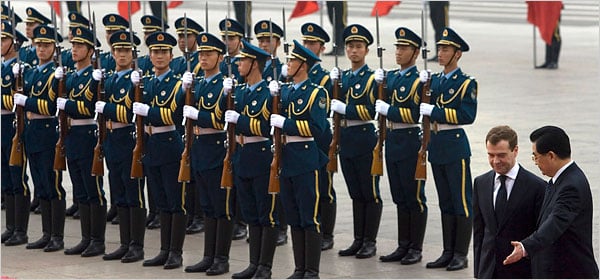
A few days ago we discussed newly minted Russian President, Dmitri Medvedev's first foreign visit to Kazakhstan, but equally if not more important to the CA region and the world at large is where he went next, China. He met with Chinese President Hu Jintao and Premier Wen Jiabao in a visit that was both strategic and symbolic as it comes in great contrast to Putin's first overseas visit in 2000 to the West's heart of London. The strength or weakness of China/Russia's relationship will have great influence in Central Asia, for the US, and for the entire world.
Strategically: During the visit the Beijing/Moscow signed a $1 billion dollar nuclear agreement for Russia to build a nuclear fuel enrichment plant in China and supply the nation with uranium. The meeting also gave the two another chance to denounce the US/EU missile defense plan in eastern Europe, Kosovo's independence, and the West's policy of exporting their values of human rights and democratic rule (which we have discussed many times). In a joint statement Hu and Medvedev stated that governments should ‘oppose politicizing the issue and using double standards’ and should not use ‘human rights to interfere with other countries’ affairs.’ This is clearly a direct challenge to recent calls by Western government and civil society groups for CA authoritative leaders and governments to open up their society's and provide their people with individual liberties. This goes at the heart of the argument that the West's policy of promoting democracy and human rights along with their strategic interests is being challenged by the Chinese/Russian model which asks few questions about a state's internal make-up when doing geopolitical/economic business.
Russia and China have many aligned interests at the moment and their current relationship is rather strong, which this first visit proves. They have performed several military exercises and called for a multi-polar world within the framework of the Shanghai Cooperation Organization. They have also stayed behind each other's view that the Iranian nuclear issue should not be taken on that aggressively by the US/West. But the two regional great powers have divergent interests, especially in Central Asia, and these will most likely keep the duo from forming anything concrete to challenge the US/West in the world or push them entirely out of CA. In fact, Medvedev's first stop in Astana, Kazakhstan was most likely a sign to China that Moscow considers the region still its main sphere of influence, especially regarding energy rights. China has made many inroads into the region, an oil pipeline with Kazakhstan and a gas agreement with Turkmenistan, and its ‘quiet expansion’ worries Russia. China has tremendous financial reserves and has proven it is willingly to pretty much outspend anyone when it comes to energy deals. Concerning energy deals between the two behemoths themselves, an oil pipeline from Siberia to China proper has been on hold for years, as the two sides still are arguing over oil prices. Another contentious issue between the two nations is the dramatic inflow of Chinese migrants into Russia's eastern lands, changing the nation's dramatically. Lastly, despite their many efforts to forge a tight relationship to combat the US/West, each side's economy is affirmatively directed towards and dependent on the US, especially China's. The two nations bilateral trade has been rising lately, but as of last year it was still less than eight times that of Chinese/US trade.
Do you think Russia/China are forming a close geopolitically strategic relationship? Is it directed toward anyone in particular? How does their relationship affect their policies in Central Asia? Is a close relationship between the two regional powers good or bad for the CA's nations?
Here are some articles that can give you a deeper analysis and picture of Russia/China's partnership or lack there of.
1. Rumer, Eugene B., "China, Russia and the Balance of Power in Central Asia," Institute for National Strategic Studies, National Defense University, 2006.
2. Yu Bin, "China-Russian Relations: Partying and Posturing for Power, Petro, and Prestige..," Comparative Connections, 2007.
3. Garnett, Sherman, "Challenges of the Sino-Russian Strategic Partnership," The Washington Quarterly, Autumn 2001.
4. Cohen, Ariel, Tkacik, John J., "Sino-Russian Military Maneuvers: A Threat to U.S. Interests in Eurasia," Backgrounder, The Heritage Foundation, No. 1883, September 30, 2005.
5. Blank, Stephen, "Can Anyone Save this Marriage: Russo-Chinese Energy Relations," Carnegie Endowment for International Peace¸ May 25, 2006.
(Photo; New York Times)
