
 The sacrifice that some children make at such young age is hard for most to imagine, but across the world many young people sacrifice their education and future to support that of their families. War, natural disasters and poverty have left many families and children seeing little options for survival and prosperity, causing many to remove children from school to enter the workforce, or even worse literally selling a child, in order to support the family.
May Thet, a teenager in Myanmar, has become the only hope to earn enough money to provide food for the family and send her younger sister to school. The sacrifice for May Thet is her education, her future;
“I feel like crying when I see my friends going to school, but, I have to console myself. It's my destiny. There are a lot of us who can't go to school because we have to help our parents. Earning the family income is much more important right now than going to school."
May Thet is lucky in some ways, as her mother has made sure that she stays close to home, despite the lure of additional income by going to work in Yangon (Rangoon), the country's capital.
“My mother said no [to my going to Yangon to look for work as a housemaid], because she was afraid I would be sexually assaulted or trafficked into the sex industry. I’m also afraid of being sold or raped. But my mother told me I cannot go there. I have to listen to my mother's orders.” (IRIN)
Almost three years after an earthquake devastated the communities in Pakistan, many stories mirror that of May Thet's, as child labor on the rise in quake-hit north. The issue of child labor in Pakistan is nothing new, however following the earthquakes devastation a substantial rise in the number of children out of school and forced to work has caused grave concern to NGO's and local authorities. NGO's estimate that some 30% of children in the region are working and the last known estimate of child labor in Pakistan in 1996 put some 3.3 million children in the labor force, while now those in the field say the problem has only increased.
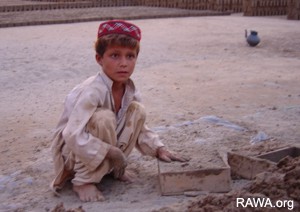 Endless cycles of debt bondage, one of the widest used forms of modern slavery, leave children forced to work towards the families debt, such as in Afghanistan's brick factories. A local NGO in Sorkhrod District of the Nangarhar Province, estimated that some 2,298 children, mostly under the ages of 15, work in the 38 brick-making factories, 90% of which are not in school (IRIN).
However child labor and low school attendance levels are not the only concern for many countries, as abuse, violence and trafficking are also at the heart of the problem. As seen after a shocking case of abuse emerged from Pakistan last month as a father of 6, clubbed 4 of his children to death. Abdul Salam, an out of work laborer, stated that he had killed the children who ranged in age from 18 months to 11 years old , as he could no longer feed them. Salam had attempted to kill all 6 of the children; however 2 of the children survived the vicious attacks. Salam told the local press that he had killed the children because he was “unemployed for 10 days and could not meet their demands”, and that there was insufficient food in the house and when he killed them they had gone to sleep hungry, he said (Lack of food prompting extreme actions by parents).
The stories of children denied an education and a future are endless, they cover the globe and while the names may change, the stories themselves remain much the same. The issue of child labor only bringing a global magnifying glass to a local issue, uncovering the root causes for the worlds some 27 million slaves. Looking through the glass one can see that sustainable solutions must be immediately put into place in communities hit by disaster to ensure that children are able to remain in school while the families are able to rebuild and recover, as well as to those communities which continue to struggle with poverty and economic hardship. Education and awareness must also be brought to both the short and long-term effects of child labor and debt bondage, in order to begin to break the cycle and see a development of sustainable and viable solutions in each community.
