
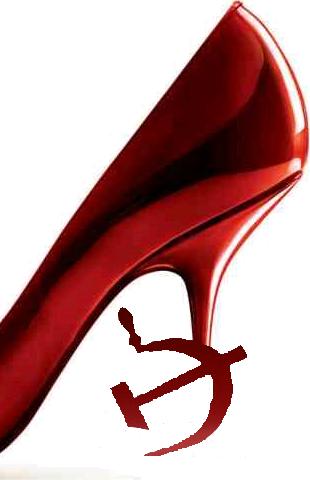
Whenever my girlfriend goes home to her native Milan, it does wonders for her Russian.
Wading through the swarm of Slav fashion slaves on Via Montenapoleone packs more listening comprehension than did her entire grad school course.
Last week, she went shopping with her older sister, who wanted to celebrate a recent promotion by treating herself to a nice pair of shoes. Her sister normally dreads buying shoes because, due to her height, she can never find any trendy ones in her size – a 9.5.
Yet, miraculously, the first designer pair that caught her eye ended up unexpectedly fitting!
Over the Russian din, the sales assistant explained to her that despite the pushiness and frequently garish attire of the posh Eastern European clientele, she had them to thank for her shoes' availability. Decades of catering to the diminutive yet voracious Japanese had finally been crushed by the Euro-proportioned Russians.
Say what you will of that country's authoritarianism and international muscle-flexing, Russia has given Italians back their fashion.
—-
OK, if this is looking like yet another puff piece, fear not: there's a deeper economic message.
You wouldn't know it judging by the anecdote above, or by the Ferragamo suits and Porsches that continue to fly out of Moscow's showrooms, but Russia's economy has taken a huge hit from the credit crisis.
For example, "Russia's stock markets are off their May highs by some 65 percent. Troika Dialog now estimates that Petrobras, the Brazilian oil major, can be bought for more than the entire Russian oil industry ‚ a staggering thought for the world's second-largest producer of crude".
But, though it is hugely affected, Russia has been weathering the crisis better than many.
No Houses to Lose
The country's lack of subprime mortgages or for that matter a credit-based consumer economy (cash and debit still being the main forms of payment for individuals) meant that at least no one is being thrown out of their homes. Yet. Indeed, as Vladimir Krendel, an analyst from the Institute of Financial Research in Moscow, was quoted by the Moscow Times as saying, “In Russia, we are comparatively pretty stable. We have not been involved in subprime banking. It used to be a drawback, but now it's our advantage".
Another way that Russia managed to avert the scale of crisis facing the US or neighbouring Ukraine, which has asked the IMF for a bailout, is the key regulatory role played by the state in the economy, and the effective use of Putin's controversial stabilisation fund.
This has allowed it to remain healthy and stable enough to not only avoid the embarrassing IMF loans sought in the wake of the 98 rouble crash, but even bail out Iceland!
In fact, so successful has Putin style economic dirigisme proved, that the West has finally started adopting some of the strategies itself, by partially nationalising the banks.
Nice to Iceland
In a diplomatic coup that has enraged the UK, Russia has pledged a €4billion to help prop up the Nordic country's collapsed economy.
“We have been calling for aid from neighboring countries and have been turned down,” [Iceland's Prime Minister] Thorisson said. “This is looking like the beginning of relations between Russia and Iceland.”
Ouch!! Not only was that a smart propaganda move from Iceland's "new friend', demonstrating its willingness to productively engage with the West , but it could also help Russia's own economic recovery:
"Moscow has unveiled a rescue package for the Russian market worth more than $210billion (£120billion), but analysts say that capital flight may not stop until global financial markets stabilise. Assisting Iceland could help to ensure that happens".
Not Seen or Heard: The Invisible Majority
Here's something you haven't been reading much of in the Western press: amidst all the column inches devoted to the personal tragedies of oligarchs sliding off the Forbes listings, there's been nary a whisper about, well, EVERYONE ELSE, a.k.a 99.99% of the population.
Such elite economic focus is nothing new, of course, but it's a sad state of affairs nonetheless. The truth is that despite all the overwhelming dominance of the “wealthy emergent Russia”narrative, living standards have begun to stagnate and costs of living to rise for the majority of the population.
However, type “Russia poverty” or “poverty in Russia” into Google News and the only poverty you’ll find is in the search results.
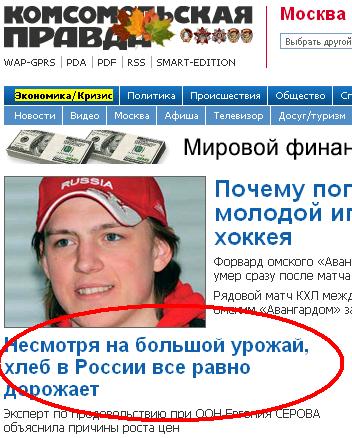
Yet, the front page of Russia's largest tabloid led (just below the shocking news of the death of ice hockey legend Cherepanov) not with a feature on oligarch finances, the price of stocks, the global financial crisis, or even Medvedev's bailout plan, but the soaring price of bread.
Too bad there's no Porsche in that story, or the LA Times might have picked up on it!
