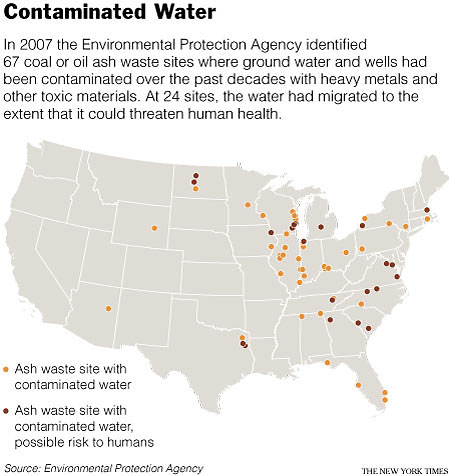
Coal Ash – I wrote last week about the horrific spill of coal ash sludge in Tennessee. (See Jan. 1 below.) Hundreds of Coal Ash Dumps Lack Regulation is the story today from the “NY Times.” There are more than 1,300 of them, “most of them unregulated and unmonitored.” What do they contain? “heavy metals like arsenic, lead, mercury and selenium, which are considered by the Environmental Protection Agency to be a threat to water supplies and human health.” The article link has an excellent video too, well worth viewing.
One of the themes of the superb documentary Burning the Future: Coal in America is the poisoning of drinking water. (I wrote about this film and what it depicts at The Crime of Mountaintop Removal Mining last May.) The “NY Times” article included this compelling graphic on the extent of water pollution from these sites.
Oil Sands – Today’s “NYT” also has an article about Canadian tar sands, their abundance – and their devastating environmental impact – The Costly Compromises of Oil From Sand. In a post from March last year, I wrote about oil sands, and flagged a potential big fly in the ointment for the “flow” of oil to the US: our energy law passed in December of 2007 limits government procurement of alternative fuels that have lifecycle GHG emissions greater than conventional ones. The article here reports: “In a recent study, the RAND Corporation estimated that oil from the oil sands generates about 10 to 30 percent more greenhouse gases than conventional crude.” Does this make any sense when we’re trying to get to a low-carbon world? Not to me. To you? (See also this characteristically terrific story from Betsy Kolbert at the “New Yorker” – Unconventional Crude.)
Aviation Fuel – The venerable Matt Wald has a good story in the “NYT” today about some trials for alternative aviation fuel – A Move Toward Veggie Power Aloft. Algae is in the mix, as is jatropha. I admit I love Algae. I also love jatropha , see the last paragraph from this post of mine from a while back. Jatropha has a great upside but not perhaps in mass production for aviation fuel. It would likely squeeze out cropland, as the NYT article reports. And, as we’ve seen a good number of times from more-than-a-few studies, biofuels are already having a negative impact on food supply and prices. See this post, for instance, and this.
Energy Security? – If you’re in Europe and you’ve been relying on Russian natural gas, you might be feeling just a tad insecure at the moment. Here’s an article from today’s “NYT” on the squeeze they’re getting. I remember hearing a high EU panjandrum at the FPA’s annual World Leadership Forum in September. I wrote here that “Unfortunately, for my money, she dwelled a little overmuch on the question of pipelines carrying oil and natural gas coming into Europe and not enough on the potential for regional and international cooperation on renewables.”
The EU has certainly embraced renewables, much to their credit, but if they want to get out from under the Russian sword of Damocles, they better pick up the pace.
************
Overall, the “NY Times” has consistently superb coverage. See their Global Warming topics page for “all the news that’s fit to print.”