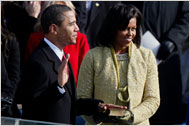
As the inauguration of President Obama fades into history I thought it would be interesting to parse out references to foreign policy in the inaugural address (text, video). Although the speech was short on specifics, President Obama did set a tone suggesting a willingness to engage the world, to lead collaboratively, and contained the requisite challenge to adversaries not to doubt American resolve. The foreign policy references and foreign affairs themes in the speech included:
Extending the hand of friendship and a willingness to lead: And so, to all other peoples and governments who are watching today, from the grandest capitals to the small village where my father was born: know that America is a friend of each nation and every man, woman and child who seeks a future of peace and dignity, and we are ready to lead once more.
A call to renew alliances: Recall that earlier generations faced down fascism and communism not just with missiles and tanks, but with the sturdy alliances and enduring convictions.
The prudent and restrained use of U.S. power: They understood that our power alone cannot protect us, nor does it entitle us to do as we please. Instead, they knew that our power grows through its prudent use. Our security emanates from the justness of our cause; the force of our example; the tempering qualities of humility and restraint.
Determination to end the wars in Iraq and Afghanistan: We’ll begin to responsibly leave Iraq to its people and forge a hard- earned peace in Afghanistan.
Multilateral efforts to combat global threats: With old friends and former foes, we’ll work tirelessly to lessen the nuclear threat and roll back the specter of a warming planet.
Resolve in the face of terrorism: And for those who seek to advance their aims by inducing terror and slaughtering innocents, we say to you now that, “Our spirit is stronger and cannot be broken. You cannot outlast us, and we will defeat you.”
Engagement with the Muslim world, warning to anti-Western leaders: To the Muslim world, we seek a new way forward, based on mutual interest and mutual respect. To those leaders around the globe who seek to sow conflict or blame their society's ills on the West, know that your people will judge you on what you can build, not what you destroy.
Engagement and warning to oppressive leaders: To those who cling to power through corruption and deceit and the silencing of dissent, know that you are on the wrong side of history, but that we will extend a hand if you are willing to unclench your fist.
Dealing with global poverty and inequality: To the people of poor nations, we pledge to work alongside you to make your farms flourish and let clean waters flow; to nourish starved bodies and feed hungry minds. And to those nations like ours that enjoy relative plenty, we say we can no longer afford indifference to the suffering outside our borders, nor can we consume the world's resources without regard to effect. For the world has changed, and we must change with it.
Support for the U.S. military: As we consider the road that unfolds before us, we remember with humble gratitude those brave Americans who, at this very hour, patrol far-off deserts and distant mountains. They have something to tell us, just as the fallen heroes who lie in Arlington whisper through the ages.
Of course, we know that these are general themes and it remains to be seen how they will translate into policy. The new president moved forward today on some specifics, taking action on Guantanamo, calling Mideast leaders, and meeting with military advisors to consider plans to withdraw from Iraq. Still to come, the Senate confirmation of Hillary Clinton as the new Secretary of State.
Author
Joel Davis
Joel Davis is the Director of Online Services at the International Studies Association in Tucson, Arizona. He is a graduate of the University of Arizona, where he received his B.A. in Political Science and Master's degree in International Relations. He has lived in the UK, Italy and Eritrea, and his travels have taken him to Canada, Brazil, Austria, Switzerland, Germany, and Greece.
Follow U.S. Role on Twitter: @FPAUSRole
Follow Joel on Twitter: @joeladavis
Areas of Focus:
State Department; Diplomacy; US Aid; and Alliances.