Russia has almost always been a thorn in the side for American diplomats. And under the watch of President George W Bush, Russia-US relations reached what many called Cold War-like lows. A growing number of commentators and analysts suggest that ties may be warming now. Both the Obama administration and the Medvedev administration have been sending out high level envoys to discuss bilateral relations. Examples: currently, former Russian President Mikhail Gorbachev is in Washington and former US Secretary of State Henry Kissinger just completed a trip to Moscow. There seems to be quite a willingness on the parts of both Russia and the US to forge a new and improved relationship. They have many issues to discuss. The issues include, but are not limited to:
The case of Iran is, ironically, the issue that could bring Russia and the US together. Fred Weir of the Christian Science Monitor writes a compelling article this weekend that makes a strong argument for the case of Obama’s Nowruz message to Iran having the added benefit of showing Russia that the US wants to build constructive ties and avoid any armed conflict in the Middle East. Weir posits that the problem is not the US and Russia disagreeing that Iran having a nuclear weapon would be a bad thing. The problem is that they disagree on how to deal with Iran and prevent it from developing or obtaining a weapon. For example, Russia remains insistent that there is no proof that Iran is developing a nuclear weapon, despite many American suggestions to the contrary alongside dubious reports from the International Atomic Energy Association. Russia has even proposed joint ventures with Iran to build nuclear plants in other nations, such as Turkey. Meanwhile, strong and more conservative American voices, such as the mogul Mort Zuckerman of the NY Daily News and U.S. News & World Report, argue that the US needs to harden its stance on Iran in order to protect American interests in the Middle East.
Obama’s message to Iran, while rebuffed by Iranian Supreme Leader Ayatollah Khameini, does send a message to Moscow that the US is willing to come to the table in a more equal way… and this could open up the door for Russia to play a larger diplomatic role in the process, thereby increasing its influence.
In any case, much will be expected of the meeting between Presidents Obama and Medvedev at the G20 summit in London in less than 2 weeks.
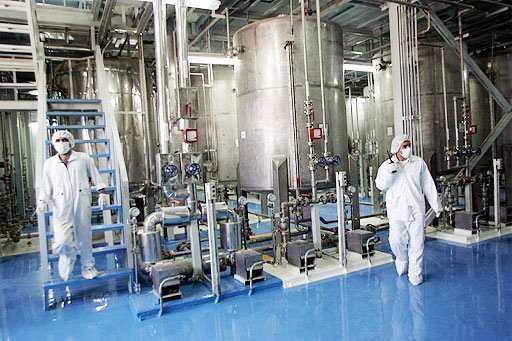
Iranian technicians at the Uranium Conversion Facilities (UCF) in Isfahan. Credit: AFP.
