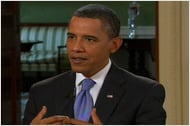
President Obama speaking to John Harwood of the NYTimes. June 16, 2009
In a small segment of a 17 minute interview President Obama had with John Harwood of the NYTimes that dealt mostly with financial regulation and health care (watch it on the link below), the president analyzed US-Iran relations in light of the election stand-off. His comment that dealing with Moussavi would not be much different than dealing with Ahmadinejad has been widely criticized for undermining the reformers in Iran. This is the trouble that highly analytical politicians can get into. Remember John Kerry?
Obama made a point that some Iran observers, generally on the right, have made, and that I made in an earlier post, that no matter who becomes Iran’s next president, it will be hard to dissuade that nation from building the bomb. This is an important insight. The probability of success in talks on nuclear proliferation with the moderates in Iran would still be low, albeit a bit higher than with the conservatives.
In spite of this analysis holding water, Obama is being faulted for saying this and for not coming out heavily in favor of the protestors. I applaud his hands-off approach, really quite unique for an American president, ensuring that conservatives in Iran have the least possible evidence of American interference in Iran’s affairs as possible. Yet the president should be careful in holding forth on foreign policy analytics, as he is not some snarky blogger seeking to impress readers, but rather the President of the United States…
Obama interview with John Harwood of the New York Times. June 16, 2009
