
The Great Recession was supposed to be the death of the decoupling debate. The theory that emerging markets were no longer dependent on developed countries for growth – and in some way insulated from the financial troubles in the West – was discredited as no one was left untouched by the economic crisis. Arvind Subramanian, a senior fellow at the Peterson Institute for International Economics and Center for Global Development, recently wrote that “all countries – rich and poor – have found themselves in the same financial maelstrom, if not in the same boat, and the effects have been substantial.”
So, the decoupling debate is over. Right? Wrong. The decoupling debate is back!
The Economist believes the biggest emerging economies will recover faster than America. (Of course, The Economist was derided by Paul Krugman, a columnist for The New York Times, and other economists last fall for having predicted in March 2008 that “decoupling is no myth…indeed, it may yet save the world economy.”) The current argument for the existence of decoupling – Decoupling 2.0 – asserts that the world’s largest emerging economies are not as reliant on consumers in the United States as most people believe and have demonstrated their abilities to respond to the crisis and boost domestic demand.
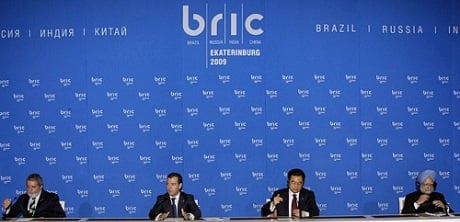
The Economist argues that even though the recent BRIC summit was “more rhetoric than substance,” the meeting “reflects growing self-confidence” among the biggest emerging markets. Could the recovery of China, India and Brazil indicate a changing global balance of power? There is some evidence that rising powers will recover more quickly than the West, as developed economies may continue to be mired in a recession.
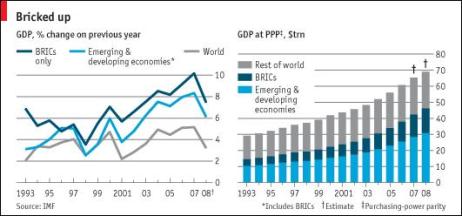
“The sheer size of the meltdown may temporarily have swamped deeper trends that are now reasserting themselves as the initial shock recedes,” writes The Economist. “In 2000 developing countries accounted for 37% of world output (at purchasing power parities). Last year their share rose to 45%. The share of the BRICs leapt from 16% to 22%, a sharp rise in such a short period. Almost 60% of all the increase in world output that occurred in 2000-08 happened in developing countries; half of it took place in the BRICs alone (see chart)…The giants seem to be decoupling not only from the West but from many of their smaller emerging brethren, too.”
M. Ayhan Kose, a senior economist at the International Monetary Fund, and Eswar Prasad, a professor at Cornell University and senior fellow at the Brookings Institution, comment in Foreign Policy that “neither the synchronized turndown nor uneven rebound is sufficient to prove decoupling true or false.”
“The bottom line is that emerging markets now seem much more capable of holding their own in the midst of a global recession,” write the authors. “They are also becoming more influential in terms of raw size – and likely to account for a rising share of global output, trade and financial flows. But to expect them to become drivers of world growth, especially in terms of helping out the advanced economies by absorbing their exports, is premature. The reality of emerging markets is encouraging but will take a while to catch up to the hype about decoupling.”
So, the decoupling debate continues. And the discussion about who will be the world’s dominate powers in the 21st century will carry on.
Photo from the Russian Presidential Press and Information Office and graphic from The Economist.
