
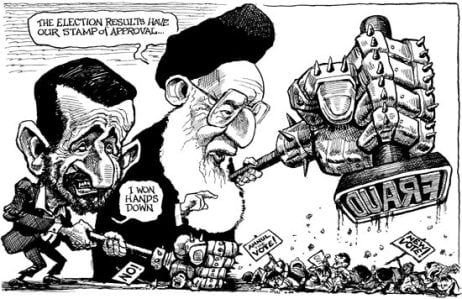
Despite the disputed election results and events of the last two weeks, diplomacy remains America’s best option with Iran. In some of his strongest words about Iran’s government, President Obama said on Friday that “there is no doubt that any direct dialogue or diplomacy with Iran is going to be affected by the events of the last several weeks.” But even though prospects for rapprochement are dampened he argued, “We don’t yet know how any potential dialogue will have been affected until we see what has happened inside of Iran.”
It is far from over, but the end of the beginning is probably here. Many analysts argue that Iran will never be the same. That may be true, but it doesn’t fundamentally change the equation for the United States – at least not now. Curbing Iran’s nuclear program is the number one objective for the US (realistically, the outside world cannot inspire immediate regime change), and diplomacy is the least bad choice.
Explicit calls for the downfall of Iran’s regime from Obama would only play into the Ahmadinejad government’s hands (as leading figures try to paint the demonstrations as internationally backed). Sure, it will be more challenging for Obama to justify negotiating with Iran and the regime may be increasingly difficult to talk to, but Suzanne Maloney, senior fellow at the Brookings Institution, argues that the show must go on. “As profound as recent events have been, engagement remains the only path forward for Washington,” she writes. “Whenever the dust settles in the tumultuous battle on the streets and behind the scenes, direct US diplomacy continues to represent the most viable mechanism for addressing Iran’s nuclear ambitions.”
Richard Haass, president of the Council on Foreign Relations, thinks that Iran “may be a theocracy in principle, but it’s increasingly a ‘thugocracy’ in practice.” He believes the US should wait to negotiate with Iran until the new reality is clear. Still, “simply ignoring this unattractive reality does not make it go away and does not make it get better.” Iran must be dealt with. “It’s unfortunate for the US that we’re prepared to talk, and in some ways need to try diplomacy, given the unattractiveness of either living with an Iranian nuclear option or using military force against it, but it has become extraordinarily difficult to talk to this regime, and Iran has become in absolute and relative terms far more capable.”
It won’t be easy, but the US should give diplomacy a try.
Visit msnbc.com for Breaking News, World News, and News about the Economy
