A Miami Herald article from last year (January 7, 2008) reported that Raúl Castro had declared a “war” on inefficient farming: food prices were excruciatingly high for the low incomes of Cuban citizens, Cuba spent $1.6 billion on annual food imports (importing 60 to 70 percent of the food consumed on the island), and still millions of acres of government-owned land lay idle.
The article continued:
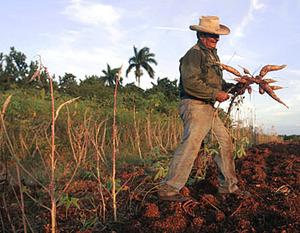
Cuban farmers have a suggestion for how the government can put millions of acres of fallow land to work and put more food on everyone’s table. Give state-owned lands to them, and allow a bit of capitalism. “We are all hoping for some change-a new system that allows you to have a better life and do some business,” said Elena, a small farmer from the Santiago de Cuba area. “Here, you are not even the boss of what’s yours.”
In October, the government began leasing the 4 million acres of fallow state lands in small parcels to private family farmers and other interested individuals. As of today, according to state media, 1.7 million acres have been divvied up on 78,113 land leases—by far the largest land distribution since the revolution, when large holdings were nationalized and some parcels granted to small farmers.
The system is not yet perfect: farmers say that it sometimes takes months to gain the land once it is granted. But it must be satisfying for the many who requested this very change.
