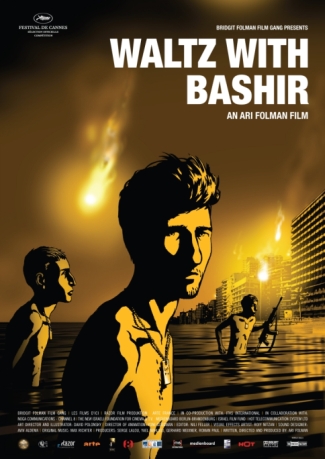
See the below film review of Waltz With Bashir from fellow FPA blogger Sean Patrick Murphy. The film, while focusing on the 1982 invasion of Lebanon, captures Israelis’ struggle with war. The Israeli government financially supported production for the film.
The details of Israel’s actions during the war were subject to significant criticism, both internal and external. Under serious domestic pressure, the government ordered a commission to evaluate Israel’s role in the Sabra and Shatila massacres. This panel, the Kahan Commission, released a report detailing testimonies and issuing censures to a series of senior government and IDF officials, including future Prime Minister Ariel Sharon who served as Defense Minister at the time. The panel did not study all of the actions of the IDF in Lebanon, instead only focusing on the massacres. The Kahan Commission found the IDF indirectly responsible for the massacre but not directly. The panel determined that the IDF should have known the massacre would occur (due to the obvious hatred of Palestinians by Phalangists) and that incompetence led to breakdowns in the chain of command, preventing the IDF from accurately understanding the situation within the camps during the massacres. The Philadelphia Inquirer’s David Zucchino characterized the report as “a unique democratic achievement” while a Los Angeles Times editorial stated, “[o]ut of the tragedy and anguish and shame has come a certain redemptive honor.”
While many analysts in the international community deemed the report surprisingly harsh and a true testament of democracy, others saw the report as flawed. In response, a commission led by Sean McBride evaluated the entire Lebanon war and Israel’s overall treatment of Palestinians. The panel found Israel guilty for a slew of issues, including direct responsibility for the massacres, even though the Phalangists committed the murders.
Testimonies to the two commissions revealed various inconsistencies that may not ever be resolved. For example, Israeli knowledge of the massacres remains disputed. Upon entering Beirut, the IDF set up its command post at the Kuwaiti embassy outside the camps. Some journalists and spectators state that the IDF had a complete view of the camps from the roof of the building. Conversely, the IDF contended that soldiers could see into the camps, but their view remained restricted due to the narrow alleyways in the camps.
The indirect versus direct responsibility continued. Israeli activists and authors criticized the IDF for its role even though Israeli soldiers clearly were not inside the camps during the massacre. Israeli author Amoz Oz accentuated this point, stating that “[i]f you invite the Yorkshire ripper to spend a couple of nights in an orphanage for small girls, you can’t later on, just look over the piles of bodies and say you made an agreement with the Ripper- that he’d just wash the girls’ hair.”
From reading both reports and additional testimonies of the massacre, the only thing we can be sure that details of events remain shrouded in uncertainty. We know IDF soldiers were outside the camps while the Phalangist militia slaughtered hundreds of Palestinians. Israel’s knowledge of the massacres as they occurred, however, remains in question.
This movie is hard to describe.
It is in part a journey back in time for director Ari Folman, who is disturbed by the fact he cannot remember incidents that happened while he was in the Israeli army.
Folman reconnects with others who were with him in 1982 when Bashir Gemayel, Lebanon’s newly elected president, was assassinated.
He slowly pieces together the events that occurred in the Israeli invasion of Lebanon at that time.
This is an Israeli film. The dialogue is in Hebrew and when Folman refers to “the massacre,” one gets the idea that Israelis know to what is being referred.
After Gemayel’s murder, his party (the Christian Phalangists), went on a killing spree in Sabra and Shatila. There, in the Palestinian refugee camps, they killed at least hundreds if not thousands of innocent victims.
“Waltz with Bashir” shows that, while the Israeli Defense Force did not take part in the slaughter, they looked on as it happened.
As for the film itself, Rotten Tomatoes’ review is that “Waltz with Bashir is as difficult to categorize as it is to forget. It is a truly startling achievement, a film that can be classified as animation and documentary and history and fiction.” The review can be found at: http://www.rottentomatoes.com/m/waltz_with_bashir/#
The animation in this movie is striking and haunting at the same time.
Also, the film’s score by German composer Max Richter complements the action well. There are also some pop songs used which help bring the viewer back to 1982.
This award-winning film is as much about memory and guilt as it is about war and atrocity and should be viewed by anyone interested in human rights, Israel, Lebanon, and the Middle East.
“Waltz with Bashir,” at 90 minutes long, is rated R.
Ben Moscovitch is a Washington D.C.-based political reporter and has covered Congress, homeland security, and health care. He completed an intensive two-year Master's in Middle Eastern History program at Tel Aviv University, where he wrote his thesis on the roots of Palestinian democratic reforms. Ben graduated from Georgetown University with a BA in English Literature. He currently resides in Washington, D.C. Twitter follow: @benmoscovitch
Areas of Focus:
Middle East; Israel-Palestine; Politics