The “War on Drugs” and the “War on Terror” over the years have both contributed to wearing out a metaphor that was already nearly useless: how can one tell when the war against an abstract concept or an undefined enemy is won or lost?
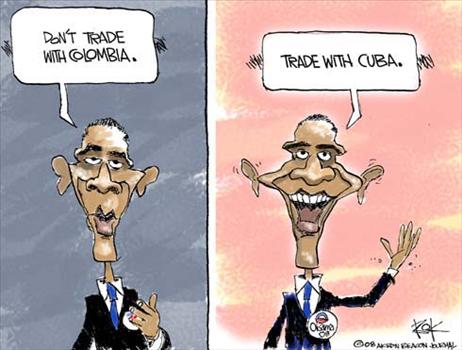
For years, U.S. administrations have employed a similarly troublesome concept in continuing to enforce the embargo on Cuba. The objective has been relatively clear in this case: uproot socialism/communism; plant seeds of democracy. But at the same time this “war” is so vague that U.S. officials and the American public did not notice for years that our strategy simply failed. If anything, the United States lost. If 47 years of embargo did not induce democracy, then we certainly aren’t “winning.”
That realization is behind the new administration’s moves to change Cuba policy. This way isn’t working; let’s change tacks, someone reasoned.
And yet, the hardheaded remain. Michael Taube, in his August 3rd op-ed contribution in the Washington Examiner, opines:
“For more than a half century, the U.S. was in control of its destiny with respect to Cuba… American foreign policy concerning Cuba, from Dwight D. Eisenhower to George W. Bush, ranged from regime change to demanding political and economic reform. Meanwhile, the Castro brothers have had to deal with a U.S. trade embargo that has crippled their economy and weakened their society… Yet in one stunning maneuver, the U.S. lost its advantage. The Obama White House made unnecessary concessions with Cuba before achieving the primary objectives that previous administrations had fought for tooth and nail… Thanks to the Obama White House, foreign companies will be encouraged to gradually invest in Cuba, creating more jobs and available goods and services. In the meantime, Castro can keep promoting communist and/or socialist principles on his island, while triumphantly showing that steps are being made toward greater degrees of free enterprise… And if the average Cuban sees an increase in the standard of living, the push toward democracy will collapse in short order.
There are a few glaring problems with his piece.
First, no state strategy to push democracy (or any other goal) should involve condoning a painfully low standard of living for an entire population. Yet that is precisely what Taube argues is a formula for success… if we just continued squeezing the Cuban people into poverty for one more administration, perhaps…
Second, he uses the phrases “in control of its destiny” and “lost its advantage” to describe the effect that Obama’s policies have had on the age-old U.S. policy toward Cuba. But when did the United States ever have the upper hand? U.S. goals have never been met. At the very best, the score is tied—zero-zero—because both countries have had their goals frustrated. But truth be told, we are down by one—zero-one—because the Castro regime has survived.
And finally, Taube seems to believe that only the United States can bring democracy to Cuba. Thanks to Obama policies, he says, any push toward democracy on the island will collapse in short order, presumably because with a higher standard of living, Cubans will be fooled into satisfaction with the communist/socialist system. This, again, is patronizing, paternalistic. Take note: democracy cannot be imposed through an embargo by the United States any more than communism can be imposed by the Cuban regime. And democracy in Cuba will come (and should come) from the people of the island themselves, not through an imposition from abroad.
