
Headlining the first Fatah conference in 20 years, the election for a new 18-seat Central Committee resulted in some serious surprises and problems for certain party members. Because some party members could not leave Gaza to vote, these officials could vote until 4 p.m.
Notably, imprisoned Palestinian leader Marwan Barghouti won, what is likely to be, a dominant role on the Central Committee, placing third in the overall votes. Barghouti, once considered a successor to Arafat even though he often opposed Arafat, is being held in Israeli prison due to his role in terror attacks. Barghouti has not renounced violence as a tactic for obtaining Palestinian independence, but he is very well respected in Palestinian circles and has shown a willingness to negotiate with Israel for a peaceful solution to the conflict. Moreover, many analysts contend that Barghouti, due to his stature among the Palestinians, could be the only viable leader that could transcend divisions in Palestinian society.
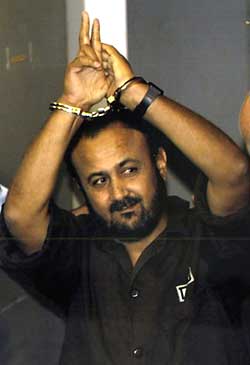
Marwan Barghouti; photo taken from Al-Ahram
Only about half of the Fatah “Old Guard” members, those affiliated closely with Arafat, won seats on the Central Committee. Most prominently, PLO and Fatah leader Ahmed Queria placed 20th, thereby losing a seat on the committee if the vote stands. Queria helped negotiate the Oslo accords and was a member of Arafat’s inner-circle. The vote confirms previous sentiments that Queria lacks popular support among Palestinians.
With the rejection of many Fatah leaders from the Arafat-years and the position documents revealed at the conference, Fatah seems to be changing its posture towards internal Palestinian politics. On one level, Fatah seems to be rejecting the Arafat approach to governance and the peace process. By ousting former Arafat supporters and embracing critics of Arafat (such as Barghouti), the Fatah party is seeking to change its identity. Instead of anchoring its image as the party of Arafat (synonymous with the party of corruption, embezzlement, and failure), Fatah seems to be searching for a new voice. However, the characteristics of the new image remains unclear. Fatah can either pursue a peace process with Israel while stifling terror groups, or embark on a violent campaign that squanders any hopes for an independent state in the near future.
Fatah officials began a selective recount of ballots because of the one-vote difference separating the 18th, 19th, and 20th slots. The top vote-getters are:
