
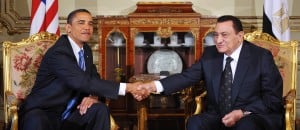
Egyptian President Hosni Mubarak travelled to Washington this week to meet with U.S. President Barack Obama to discuss the Israel-Arab peace process, Palestinian faction reconciliation, and attempts to secure the release of captured IDF soldier Gilad Shalit. Preceding the meeting, Mubarak granted numerous interviews with the U.S. media, most notably with PBS anchor Charlie Rose.
Mubarak’s talks with Obama are significant because they reflect a unified Arab-U.S. approach to the peace process. Both statesmen expressed enthusiasm for recent Israeli moves indicating agreement to at least a partial settlement freeze. Moreover, U.S. support for a peace process that would involve diplomatic ties between Israel and the Arab world puts renewed clout behind plans like the Arab Peace Initiative that was also supported by the previous U.S. administration.
Mubarak’s stance on the peace process, reiterated in interviews and a recent Wall Street Journal op-ed penned by the leader, focuses on the need to completely revamp the methodology used to achieve a solution in the region. Instead of focusing on developing stages for the process that includes confidence building measures, Mubarak urges the development of an all encompassing peace plan that would mandate the creation of a Palestinian state, provide full diplomatic relations between Israel and the Arab world. He supports this idea by referencing the Camp David process negotiated between Egyptian President Anwar Sadat, Israeli Prime Minister Menachem Begin, and U.S. President Jimmy Carter. Mubarak also blamed the failure of Shalit talks on Israel for placing unfair restrictions and criteria on prisoner swaps with Hamas. To emphasize his role in the negotiations, Mubarak even called Shalit “our soldier” to accentuate Egyptian responsibility in the matter.
In the interview with Charlie Rose, Mubarak said:
“I just wonder why you are not aware of the role Egypt is playing in this process. You are asking about the role of Egypt in this process. I think you are very much following this and you are a noted media man. We have a major role in this issue. We share boundaries with the Palestinians. We share boundaries with Gaza, Jordan shares boundaries with the West Bank. The stability of this part of the world means the stability of the Arab region. But failing to solve this issue when jeopardize the stability of even the globe itself, we are trying to solve the problem between Hamas and the authorities in the West Bank because this is quite an important, we should fill the gap here and we should bridge the gap because, unless we reconcile their differences, there will not be stability there, there will not be stability even in Israel. Violence will recur. We are doing our best to bring about stability without which and without solving this issue, the facts on the ground will be very, very challenging.”
In the interviews, Mubarak played the role of an elderly statesmen who effectively orchestrated unprecedented agreements, only to have the individual players- Israel, in particular- reject the compromise last minute. If Mubarak actually was the lynch-pin in negotiations then many other issues would already be resolved in the region. For example, Cairo has hosted multiple summits of Palestinian reconciliation talks between Hamas and Fatah in order to unite the Palestinians under one government. Instead, each conference has repeatedly failed and produced only minor successes between negotiators before erupting into renewed disagreements.
While Mubarak’s individual clout in the process remains relatively minor, his approach may succeed. In the past, peace processes included numerous confidence building measures that provided multiple opportunities for failure. If either Israel or the Palestinians broke any aspect of the agreement, however minor, the entire peace process would crumble. By removing the “stages” aspect to the peace agreement, the parties would compromise on every aspect of Palestinian statehood that ensures Israeli security. An overarching agreement, which provides Palestinians with the “end goal” of a statehood from the beginning, could remove the potential for smaller infractions to completely dismantle a peace process. However, an all encompassing peace plan without stages would not provide Israel guaranteed security. The immediate establishment of a Palestinian state in striking distance of Tel Aviv could create a major security threat that would have the potential to immediately create a war between Israel and Palestine. If, like in Gaza, the West Bank became a haven for terrorism, Israel would have no choice but to militarily overpower the Palestinians, at any cost. Therefore, Mubarak’s plan could be the true solution to the Israel-Palestine conflict, or it could result in pure tragedy.
Mubarak supports Obama’s vision for the peace process and lauded the new U.S. President as a friend of Islam, a stark contrast from the perception of the previous U.S. administration. Mubarak said:
“The Islamic world had thought that the U.S. was against Islam, but his (Obama’s) great, fantastic address there has removed all those doubts.”
Photo taken from CNN.com
