
Around Cuba’s capital Havana, it is quite remarkable how often you see a neatly tended plot of land right in the heart of the city. Sometimes smack bang between tower block estates or next door to the crumbling colonial houses, fresh fruit and vegetables are growing in abundance.
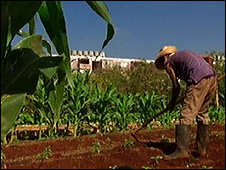 So begins Sarah Murch’s piece in the Herald de Paris on Cuban “city farming.” She notes that after the fall of the Soviet Union, Cuba had to restructure its agriculture industry from mono-culture and fuel-thirsty to self-reliant and low-input. Oxen again began to plow the land, and farmers, without the oil-based fertilizers and pesticides that were previously available, turned to natural and organic replacements. Urban land allotments began to proliferate.
Now, about 300,000 oxen work on farms across the country and there are now more than 200 biological control centers producing biological agents in fungi, bacteria and beneficial insects. On the many small city plots, creativity is key: repellent plants like marigolds are planted around crops to keep away pests, and sunflowers and corn surround the bed to simultaneously attract beneficial insects like ladybugs. Co-ops sell their fresh products locally to schools, hotels, restaurants, hospitals, and directly to the people.
The author says that methods like this have helped Cuba increase its food production to become 90% self-sufficient in fruit and vegetables, and allowed Cubans to develop a less fatty diet than many Western countries, with an average calorie consumption only slightly below that of the UK.
