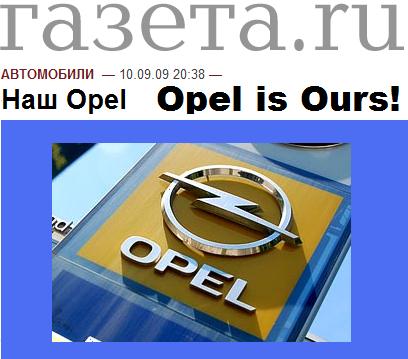
That was the slightly exaggerated headline that the popular online newspaper Gazeta ru gave to GM’s decision to sell off the majority stake in Opel to Magna, a consortium of Candadian-Austrian businesses and Russian state controlled Sberbank.
In its triumphalism, news of the sale brings into stark relief the contradictions of the new Russia, whose increased financial integration with the West comfortably accomodates a simultaenous political and cultural retrenchment.
A stunningly literal example of this trend was recently highlighted in Russia Profile magazine. In an article entitled ‘The Truth Russians Can’t Know’, Roland Oliphant writes of how the Russian edition of GQ, the popular mens lifestyle magazine, voluntarily chose not to run a story that appeared in its US edition alleging Putin’s involvement in the Moscow apartment building bombings of 1999.
Yet not only did free-market considerations not prevent such clampdown on press freedom, but they may have actively contributed to it:
“Why bury a relevant story?’, asks Oliphant. “Anderson [the writer of the original piece] himself is skeptical that the publisher is reacting to a specific request from the Russian authorities. “I strongly doubt that anyone told Conde Nast not to publish the article,” he said. “Rather, I think they acted preemptively and that the steps they took to minimize the article’s impact were done for a mixture of legal and economic reasons.”
“Conde Nast has made a significant investment in the Russian glossy magazine market, publishing Russian versions of Vogue, Glamour and Tatler, and a furniture catalogue called AD magazine, as well as GQ. For a cautious executive, that might be a good reason to stamp on any article that might rile the wrong people”
This news comes on the heels of reports that “Mikhail Voitenko, a Russian journalist who specializes in maritime reporting, fled abroad after he said he received threats for his reporting that [a Russian ship that had ostensibly suffered a hijack] was likely being used by corrupt officials to carry weapons”.
“Speaking to the BBC from Turkey, Mr Voitenko said he had received a threatening phone call from “serious people” whom he suggested may have been members of Russia’s intelligence agency, the FSB. ‘As long as I am out of Russia I feel safe,” Mr Voitenko told the BBC. “At least they won’t be able to get me back to Russia and convict [me]’.”
This sort of thing should come as no surprise to anyone who has seen the unsavoury involvement of both willing businesses such as Google in Chinese censorship. However, it bears repeating that a greater commerical integration of Russia into the global economy, via free trade pacts such as the WTO for example, is unlikely to resolve its democratic crisis.
