
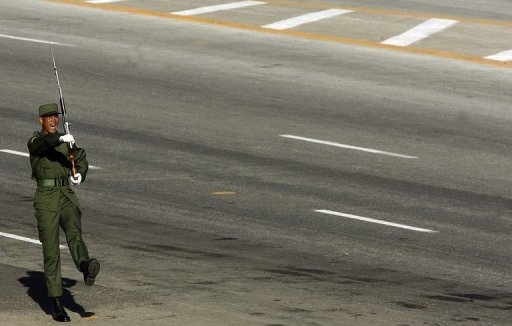
Over the past few days, an overlap between two of our Cuba blog posts has highlighted one of the most defining problems of the relationship between the United States and Cuba—a lack of communication. First, Cuba announced that it would hold military exercises nationwide in the coming week (see Wednesday’s post). Then U.S. President Barack Obama exchanged notes with Yoani Sanchez (see Thursday’s post), emphasizing in response to one of her questions: “The United States has no intention of using military force in Cuba.”
Then yesterday, the Cuban military clarified its exercises scheduled for this week as an effort to boost preparedness against any future attack by the United States, saying: “It is a necessity of the first order given the political-military situation that now defines relations between Cuba and the empire.”
What military situation? Cuba is no longer considered a threat to the United States (the idea has been ludicrous for some time) and the current administration has done nothing near to threatening invasion or intervention to pursue its goals in Cuba. In fact, Washington has emphasized a number of times that it intends to put pressure on the island only through dialogue and at most through a continuation of the embargo, but hopes to make progress past this anachronistic apparatus if Cuba will also agree to cede a bit of ground in the 50-years-ongoing debate over democracy and human rights on the island.
If the two sides cannot have open dialogue, then both will continue to be able to perpetuate misinformation about the other. And this creates what is perhaps the largest rift between the two countries.
