
They were blasts heard round the world, except on Russian TV. And in the wake of the Moscow bombs, many Russians have condemned “the near-silence of the state-controlled TV channels hours after the explosions”, according to the BBC.
One blogger, Anton Nossik, noted that a full 3 hours after the attacks, “he found normal daytime TV still in full flow on most, at a time when foreign networks were reporting live from Moscow”.
Even Russia’s vibrant social media scene ‘failed in covering the Moscow metro bombing’, according to Catherine Fitzpatrick, a commenter on Global Voices Online.
“Of course there are no shortage of comments and tweets,” she writes, ‘but the reality is, *the same few pictures which don’t tell anything but an official narrative* are being regurgitated everywhere, and little but *the official narrative* is being reiterated. Citizens’ coverage isn’t leading to independent investigation and even commentary; it’s retweeting what the prosecutor and the mayor are saying, with the exception of a few extreme opposition figures and supporters saying “it was an inside job” without any actual investigation.
Yet one news outlet not only aired a special news bulletin on the bombings, but also filed many live dispatches from the blast sites and a hospital. As far afield as London and Washington, its square green logo could be seen on the footage hosted by CNN and the Guardian.
That station was Russia Today, recently rebranded RT, one of whose anchors, Yulia Shapovalova, was herself an eyewitness.
Funded by the government and supervised by Russian state media service RIA Novosty, RT courted controversy since its inception in 2005.
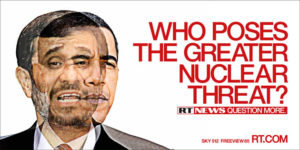 It is widely considered to be “a Kremlin project to improve Russia’s image around the world” and accused of airing obscure conspiracy theorists to promote an anti-Western agenda.
Its 2009 advertising campaign, featuring a picture of Barack Obama superimposed with the image of Iran’s Ahmadinejad under the slogan “Who poses the greatest nuclear threat?”, was banned from US airports.
Yet its outspoken young boss Margarita Simonyan remains unapologetic:
“We offer an alternative to the mainstream view,” she told The Guardian. “I don’t believe in unbiased views. Of course we take a pro-Russian position. The BBC says it openly promotes British values.”
At the same time, ‘she gets quite emotional when asked whether national television is an example of a rollback of media freedom.
“Yes, but only if we exclude the Internet, newspapers, magazines, radio, regional and private television,” she says. “How can national television eclipse thousands of other media outlets?’
So what to make of RT? Is it just another propaganda organ?
Not quite. For starters, while it continues to fall short of some journalistic standards (leading to the angry resignation of a senior reporter over coverage of the Georgia-Russia war), it is considerably more liberal than Russian terrestrial TV or its parent RIA Novosti.
For example, it quotes and interviews researchers from the liberal-atlanticist Carnegie Center (albeit when the soundbites are uncontroversial/suit the state narrative).
In this way, it resembles the online magazine Russia Profile, which is published by RIA Novosti but partners with several European think tanks and lists such figures as Leon Aron on its advisory board. And while it is generally detail orientated, Russia Profile frequently prints articles, many written by foreigners, that criticise the regime, such as this one by Tom Balforth on the assault on press freedom.
One other way in which RT sometimes fulfills its remit to offer an alternative view of Russia is its interviews with people such as Katrina Vanden Heuvel, whose radical views are not well represented in the Western mainstream media’s coverage of Russia.
Of course, barring such occasional nuggets, RT is still not mature, independent or editorially conscientious enough to be a default source of Russia news for mainstream Western viewers. But for those with enough knowledge of the country to be able to separate its wheat from its chaff, RT can offer a fresh and provocative take.
It’s definitely not Pravda, but it could easily be an official Russian version of Fox News.
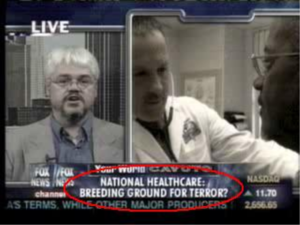 Fox also has clear political agenda, and features some guests and anchors (Glenn Beck, Sean Hannity, Laura Ingraham) who espouse extreme views (eg. encouraging the Tea Party protests) and spout bizarre, conspiracy theory-laden rants.
Somewhere amidst all of that, there is a small straight news operation that (mostly) delivers the goods; and even if they only challenge their ideological foes, sometimes that challenge is legitimate.
But the most important thing Fox and RT share is a common origin myth.
Writing in the Columbia Journalism Review, Terry McDermott describes
a loopy self-absorption to this that is peculiar to Fox and that derives from its origin narrative as the network for the unrepresented, for the outsiders. There is a strain of resentment, of put-upon-ness that pervades almost everything Fox puts on the air.
In its obsession with Western ‘misrepresentation’ of a Russia struggling to be heard above the lies and calumny of its foes, McDermott could easily have been describing Russia Today.
