
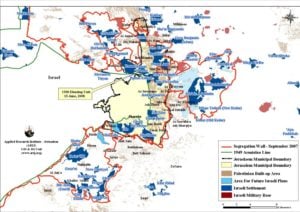
Tensions between the United States and Israel have rapidly escalated lately, fueled in part by continued Israeli construction in controversial areas, including East Jerusalem.
The Obama administration has repeatedly implored the Israeli government to expand a freeze on settlements to include Jerusalem, an issue at the forefront of meetings last week between Prime Minister Binyamin Netanyahu and high-ranking U.S. officials.
Meanwhile, Palestinian leadership continues to use ongoing construction, including housing projects in Jerusalem, as fodder to refrain from entering any type of negotiation with Israel, heralding the issue as an excuse to avoid the real impediments to peace – Palestinian refusal to give up the right of return and an inability to unite under the same banner.
Settlement construction and new housing projects in East Jerusalem are tangential issues to the resumption of peace talks. Palestinian leadership has resisted even minor concessions on the right of return and instead continue to trumpet the issue among the population, even though permitting hundreds of thousands of Palestinians to settle beyond the Green Line is an unrealistic proposal that is opposed by nearly every segment of Israeli society.
Moreover, Palestinians remain a divided people, with the Abbas administration lacking any authority over the Gaza Strip. The Hamas-led Gaza government will not abide by agreements between the Palestinian Authority and Israel, opting instead to resume terror by continuing to launch rockets into southern Israel.
Even though, in reality, the settlements and construction in Jerusalem are tangential issues to the resumption of peace talks, the Netanyahu administration should concede on settlement construction by extending the temporary settlement freeze and expanding the scope of the halt in construction to encompass East Jerusalem.
This gesture to resume peace talks would force the Palestinians to make a choice. The Palestinians would no longer have settlements as an excuse to withhold from peace talks and coerce the Abbas administration to either begin new negotiations or reveal that the Palestinian Authority – not Israel – is the true barrier to peace.
The Netanyahu administration would also prove to the world and the White House that settlements are not the biggest hurdle to peace, but are instead an easy target for the international community to attack. By removing settlements and housing construction in Jerusalem from the equation, the Obama administration would face no choice but to exert the same pressure on the Palestinians to make concessions, resume negotiations with Israel and clamp down on terror.
Israeli concessions on settlements could also result in an unlikely unintended consequence – it could work. An end to housing construction in East Jerusalem and increased settlements in the West Bank could result in Palestinian officials agreeing to resume talks. Those negotiations could lead to an agreement that would end the decades-long conflict by providing Israel with security and the Palestinians with their own state, an outcome sought by a large portion of Israeli society and the international community.
In the past, Israel already has conceded on some major issues, including the withdrawal of settlements from the Gaza Strip. However, that gesture simply did not go far enough and focused on the wrong areas.
The population in the Gaza Strip has had limited resources and generally sought the right of return far more than West Bank residents. The de facto creation of an independent Palestinian state in the Gaza Strip was doomed to failure, with the area lacking a viable economy and the population far more radical than their cohorts in the West Bank.
Conversely, the West Bank has a more successful economy that is growing, thanks in no small part to Palestinian Prime Minister Salam Fayyad, a former World Bank and IMF official, who is prioritizing institution building in the territories that includes major financial reforms.
Israel’s previous efforts to concede policy points for peace focused on the wrong issues and the wrong places. A full freeze on settlements in the West Bank and housing projects in East Jerusalem might enable negotiations with the Palestinian Authority, thereby furthering prospects to end the conflict.
More importantly, an end to controversial construction would force Palestinians to make a choice to either support U.S. efforts to end the conflict or reveal the true impediments to peace – a draconian ideology that is incompatible with the peace process.
The Israeli government can’t lose – either the peace process resumes or the White House has no option but to acknowledge Israel’s efforts and shift its target from the Netanyahu administration to the Palestinians.
Netanyahu should agree to U.S. demands and call the Palestinian bluff, shining a spotlight on the true barriers to peace.
