As the United States and Russia sign a nuclear arms treaty and the world’s leaders are preparing to discuss nuclear weapons at length next week, Israel isn’t interested to chat about the sensitive subject of its nuclear arsenal. Complicating the issue reportedly are key Israel allies that could be attempting to gain legitimacy in the Arab world by condemning the Jewish state.
Nearly 50 world leaders will descend on Washington D.C. next week to take part in the Nuclear Security Summit hosted by the White House, and some countries are reportedly intending to take Israel to task over its refusal to sign the Nuclear Nonproliferation Treaty.
In response, Israeli Prime Minister Binyamin Netanyahu has decided not to attend, sending a deputy instead to deal with the diplomatic circus. An Israeli official tells Politico:
“In the last 24 hours, the Israeli government has learned of various reports from various sources on the intention of several states attending the conference not only to deal with the issue at hand, but to take the opportunity to make a point of grand-standing against Israel and the issue of the NPT… The prime minister was dismayed at this, and decided to stick to the Israeli policy that Israel is usually represented at these types of conferences at the professional-ministerial level. As such, Deputy Prime Minister Dan Meridor and a professional team will come to Washington to attend the conference.”
The countries expected to flaunt Israel’s refusal to sign the NPT are reportedly Muslim countries. Some reports say Egypt and Turkey are spearheading efforts to bring up Israel and the NPT, an interesting development particularly because Egypt and Israel are coordinating anti-terror efforts. This ongoing cooperation has helped fuel the rise of the opposition in Egypt, particularly from the Muslim Brotherhood, which has ties to Hamas. This condemnation from Egypt could be an effort from Egyptian President Hosni Mubarak to regain some credibility from anti-Israel opponents that have lambasted the government for its ties to Israel.
Similarly, Israel and Turkey have fueded lately, particularly due to Turkish Prime Minister Recep Tayyip Erdogan’s efforts to court the Islamic world. He has publicly and repeatedly chastised Israel for Operation Cast Lead. Further, Israeli officials have snubbed their Turkish counterparts, leading to further complications in the relationship.
While these countries are using the opportunity to slander Israel, the Israeli nuclear program has long been viewed as stable and not sparking an arms race in the region or enabling terrorists access to the material. Conversely, the NPT has largely focused on preventing terrorists and rogue nations from gaining nuclear capabilities, something not an issue with Israel.
While Israel has never admitted to having nuclear weapons, the country has long been suspected to having developed nuclear bombs long ago under the direction of current President Shimon Peres. Israel has rebuffed efforts and pressure to sign the NPT, primarily to avoid disclosing the depth of its nuclear weapons program. Even though some Arab countries have opposed Iran obtaining a nuclear weapon, those same countries are more sympathetic to Israel having the capabilities because the Jewish state does not flaunt those weapons and will not spark an arms race in the region. Conversely, a highly developed Iranian nuclear program would likely stir-up the arms race, with other countries eager to follow suit and maintain clout and security in the region.
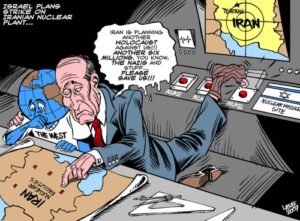
Cartoon from here.
