
Foreign Policy Blogs

Yes, We Can – Part Deux

I wrote a couple of weeks ago that we most certainly can eliminate coal-fired power plants.  Well, according to the US Energy Information Administration (EIA), we not only can, we’re on that track now.  How?  The answer lies partly in the switch to natural gas.

The FT quotes the EIA here:  “… in 2009, the carbon intensity of the electric power sector decreased by nearly 4.3 percent, primarily due to fuel switching as the price of coal rose 6.8 percent from 2008 to 2009 while the comparable price of natural gas fell 48 percent on a per Btu basis.”  And gas is not only cheaper, it’s, as we know, much cleaner than coal.  Here’s a chart from the folks at America’s Natural Gas Alliance (ANGA) that illustrates to what extent.

450coal-v-gas

These are convincing numbers.

The FT story is in the context of the fact that in the US “…carbon emissions fell 7 per cent in 2009 – the biggest fall since the records begin in 1949, according to the EIA.”

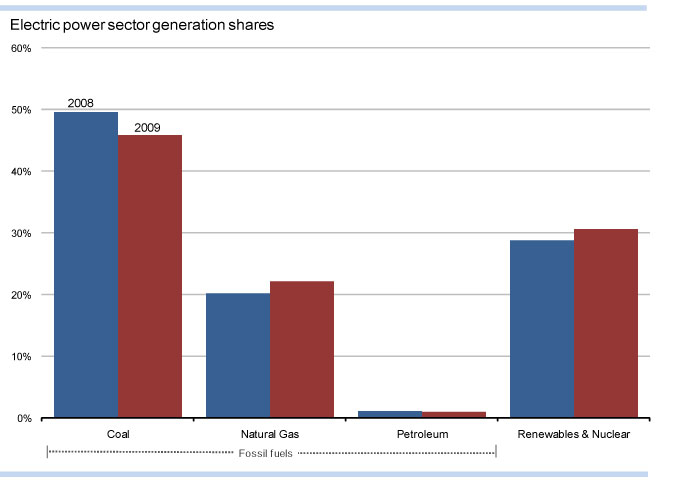
This chart from the EIA tells the story of the ongoing power industry fuel-switching from coal to oil.
450eiapowergeneration

The FT says “The death of US coal, it seems, is marching on.”  Dead man walking, in my view.


Author

Bill Hewitt

Bill Hewitt has been an environmental activist and professional for nearly 25 years. He was deeply involved in the battle to curtail acid rain, and was also a Sierra Club leader in New York City. He spent 11 years in public affairs for the NY State Department of Environmental Conservation, and worked on environmental issues for two NYC mayoral campaigns and a presidential campaign. He is a writer and editor and is the principal of Hewitt Communications. He has an M.S. in international affairs, has taught political science at Pace University, and has graduate and continuing education classes on climate change, sustainability, and energy and the environment at The Center for Global Affairs at NYU. His book, "A Newer World - Politics, Money, Technology, and What’s Really Being Done to Solve the Climate Crisis," will be out from the University Press of New England in December.


Areas of Focus:
the policy, politics, science and economics of environmental protection, sustainability, energy and climate change

Contact