
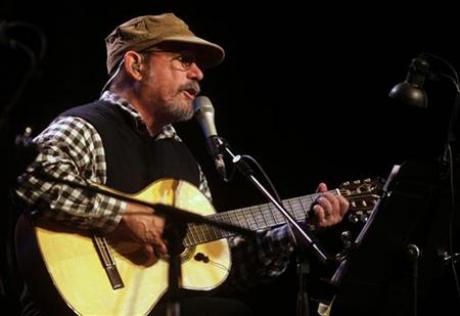
Lately music appears to be the only successful avenue for achieving greater US-Cuba exchange, and likewise for expressing critique of the government on the island. Something about this medium allows for greater flexibility on both counts.
Silvio Rodriguez, the Cuban folk singer that has been called “the voice of the Cuban revolution” for his songs that extol its virtues, has actually lightly criticized the country’s system of one-party Communist rule and warns in his newest album that if Cuba does not change, outsiders will force it to. Other folk singers have issued more severe rebukes and controversial statements: Carlos Varela recently told a Miami radio station that he admired the Damas de Blanco (Ladies in White), the group composed of wives and mothers of Cuban dissident prisoners that Cuban authorities dismiss as a club of foreign mercenaries. Pablo Milanes told Spain’s El País newspaper that Havana officials were “stuck in time,” and defended dissident hunger striker Guillermo Farinas for demanding the release of dissident prisoners.
Furthermore, Rodriguez has just secured permission from both the United States and Cuba to tour and play several shows in the USA (New York, Chicago, Los Angeles, San Francisco and Puerto Rico) for the first time since 1979. Last year, his visa request did not receive a response from U.S. officials in time for the visit to New York City he had hoped to make.
Folk singers are not the only singers bordering on “dissidence”: Cuban underground rappers Los Aldeanos are even more forthright about their complaints. Some of their most dangerous lines: “All of this/one day will change/for the good of the people,” and “So many are dead/or in jail/people would rather die for the American dream/than live through this Cuban nightmare.”
For now, these groups are enjoying a bit more freedom in the Cuba and the United States than is customary. For now, there has been no pushback from Havana or Washington. For now.
(Photo: Reuters/Jorge Adorno)
