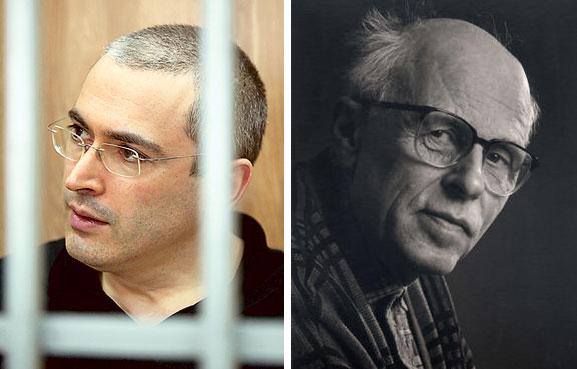
Everyone knows that the physicist turned human rights crusader Andrei Sakharov was a dissident, but what about oligarch turned oppositionist Khodorkovsky?
The idea of a dissident with overseas bank accounts and an army of lawyers and publicists writing blogs and Twitter feeds on his behalf from safe quarters in London and Washington seems paradoxical.
However, they argue, in a country whose government has silenced and decimated all the traditional agents of dissent – journalists, academics, scientists – “open defiance… is left to a robber baron with a murky past, a billionaire dissident for a new era in a country that may have shed its Soviet skin but not its autocratic skeleton”.
As a neo-perestroika liberal whose respect for Sakharov has been matched by a disdain for Khodorkovsky, I must admit to being very uncomfortable with such a comparison. After all, one man was a feted scientist who threw away his status and comfort to fight for justice, while the other was a billionaire who made his money in shady ways and then fought for his own political power.
Refreshingly clear-eyed, Glasser and Baker acknowledge this:
Khodorkovsky was no Solzhenitsyn. He may have been headstrong, but what he cared about most was acquiring money and power…
By age 30, he was buying state assets through manipulated auctions. He acquired control of Yukos, then the country’s second-largest oil producer, for a paltry $309 million in a 1995 auction run, conveniently enough, by his own Menatep bank.
Indeed, if for Sakharov, imprisonment was the punishment for his ideals, for Khodorkovsky it proved to be an incubator. Note Glasser and Baker:
In his first 40 years, Khodorkovsky had been many things — a hustler and a banker, an oilman and a philanthropist — but never a political thinker or writer. Putin has turned Khodorkovsky into both.
On the other hand, it’s hard to deny that the man has changed. He has repudiated the privatisations of the 90s that made his own fortune, and even gone so far as to call for a ‘left turn’ in Russian politics,
denouncing the liberals who had run Russia in the 1990s — and whom he had supported with millions of dollars. They were “dishonest or inconsistent,” “effete bohemians” who “cheated 90 percent of the population” and “turned a blind eye” to the corruption of privatization. They should feel “a sense of shame.” As for himself and his fellow oligarchs, “We were accomplices in their misdeeds and lies.”
Some of Khodorkovsky’s new positions have even confused his family and friends.
The most important issue, however, is the meaning of ‘dissident’ itself. In the West, the word has taken on a big moral hue that has distracted from its original meaning, which was often a pejorative in the USSR and remains less than positive in Russia.
As Benjamin Nathans points out in the current issue of the London Review of Books:
In Russia, disenchantment with the dissidents is almost as widespread as disenchantment with socialism.
And back in the USSR, the original dissidents were just about as unpopular among ordinary people as Khodorkovsky is now. Contrary to the hopes of Radio Liberty and Helsinky activists, they enjoyed very little support, much less than the legitimacy and support enjoyed by the state.
Because of their backgrounds in academia and art, their unabashedly highbrow tastes, and their residence in Moscow and St Petersburg, 70s era dissidents were derided as privileged, cosmopolitan poseurs disconnected from the more prosaic struggles of the common people.
Their calls for abstract rights was seen as a luxury by most Soviets, whose pressing needs were often of more basic survival such as finding groceries or a place to live. The dissidents’ penchant for such foreign exoticisms as democracy and human rights, consumption of foreign radio and ties to Western rights organisations was seen as cryptic and unpatriotic. Moreover, the Jewish background of most dissidents did nothing to endear them to a population that generally viewed Jews with suspicion and prejudice.
All in all, their links with the West, their Bohemian lifestyles, their rejection of Soviet mores and their Jewishness made dissidents seem suspicious outsiders of dubious loyalty. Sort of the way the Red Staters and Tea Partiers in the US feel about the liberal intelligentsia.
Surprisingly little has changed since those days. Today, as in the 1970s, a majority of people still either passively accept or actively support the government and have a low opinion of dissidents, including Khodorkovsky.
As Glasser and Baker point out, “pockets of opposition emerge from time to time, but to little effect. On Khodorkovsky’s birthday last year, a handful of protesters near Red Square was arrested. No one much cared”.
And the parallels don’t stop there. According to Nathans, the central goal of the Sakharov-era dissidents was
a wish or a determination that the Soviet state should obey the letter of its own laws, especially those governing civil rights and due process.
That same modest and legalistic determination, that Russia follow its own laws, was precisely what motivated Khodorkovsky’s recent hunger strike.
But perhaps the most compelling reason to declare Khodorkovsky a dissident, (however reluctantly) is the same one that has made ordinary Russians hate him.
As Nathans writes,
The [Soviet] dissidents…engaged in ‘resistance without the people’ – a people who, in the meantime, had become literate and urbanised, if not exactly urbane. In keeping with their law-based strategy, the dissidents aimed to sway the hearts and minds of Soviet lawmakers. When that failed, they turned to foreign journalists in the hope of shaping Western public opinion, where they succeeded spectacularly
Khodorkovsky, the Westernised and Western-looking billionaire, is also waging a campaign of resistance without the people. His feud is and always has been with the very top- with Putin; he has not cared to take the conflict to the masses, preferring instead to use the foreign media and a small handful of Russian intellectuals to deliver his message.
In this way, Khodorkovsky falls far short of the revolutionary hero that Russia needs: but then again, so had the dissidents themselves.
