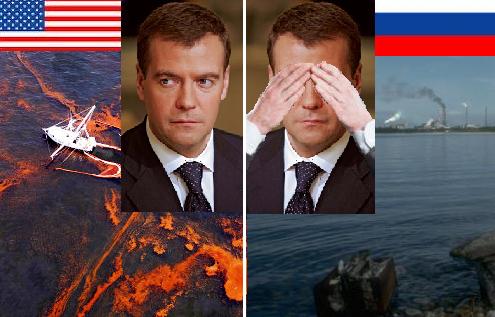
Outraged at the water pollution caused by the BP oil spill, “Good Cop” Medvedev proposed today a global fund to ensure against and deal with such disasters in the future.
But as any schoolboy knows, Russia has had very few qualms about destroying its own environment.
Putin may talk a nice talk about how “Russia’s nature is a gift from God…and deserves our protection”, but Medvedev’s comments coincided with a grim assessment from Greenpeace of Russia’s “destructive environmental legacy over the past decade” – ie. since Putin’s ascension.
And this is no coincidence. As Greenpeace Russia’s director Ivan Blokhov points out in the article by Gary Peach, “it was Putin who, just days after being inaugurated president in 2000, abolished the country’s forestry service and environmental protection committee — depriving the country of independent environmental regulators”.
But the Kremlin’s role in ecological degradation does not stop at simple deregulation. Ekho Mosvky and Gazeta.ru report that authorities have just broken up a demonstration in Red Square organised by the liberal Yabloko party protesting against water pollution in Lake Baikal from a paper mill owned by a crony oligarch.
To update an old joke from the Brezhnev era:
An American says to a Russian, “In my country, anyone is allowed to come up to the White House and denounce environmental pollution in American waters”.
“Big deal!”, replies the Russian. “Here anyone is equally allowed to come to Red Square and denounce environmental pollution in American waters!”
