How did Russia soften up stubborn Belarus into entering the Customs Union that Lukashenko had so strongly resisted?
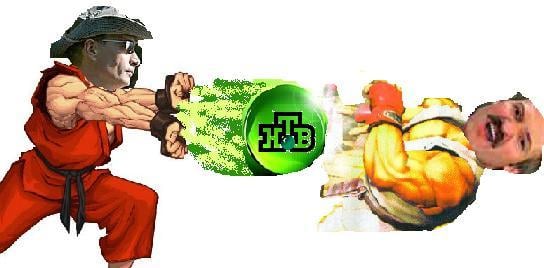
In part by openly using the media, and specifically NTV, as a tool for diplomatic hardball; disproving all those liberal haters who predicted irrelevance for the formerly critical channel after its takeover by the Kremlin.
To send a message strongly encouraging Lukashenko to sign the customs treaty, this weekend NTV aired a vicious hit piece on the Belarussian leader entitled The God-Daddy (a pun on his popular nickname ‘Daddy’).
The 30 minute film, which plays like an angsty post-breakup letter from a spurned teenager to his ex, is an innuedo-laden and sensationalised mashup of all the most damning and embarrassing pictures, videos, quotes and news stories involving Lukashenko.
It ends with this explicit threat: “Can Lukashenko win the respect of the West, even at the expense of his relations with Russia? Maybe, but not for long”.
The charges levelled against him range from the ridiculously trivial (there’s a clip of Lukashenko incorrectly calling one prose novelist a poet) to the conspiratorial (he is openly accused of ‘disappearing’ and murdering former henchmen who had turned against him).
What makes the show so unsettling is not just its 1930s polemical style or vicious one-sidedness, but rather the Orwellian realisation that much of what we now see accompanied by campy vampire-film music was either supported, purposefully downplayed or unreported by the same channel as recently as a few months ago, when Lukashenko was Russia’s big ally.
Equally chillingly, NTV’s English language counterpart, Russia Today, has recently been ordered to start calling Lukashenko ‘Europe’s Last Dictator’, a moniker that Russia had earlier criticised the US for using.
But, did it work?
Very well, judging by the hysterical reaction from Belarus’s own state controlled media:
In a sometimes hilariously translated article, Minsk’s Telegraf (sic) reported a government mouthpiece being
outraged by “continuing flagrant media attacks on the president, on our country”, which was named by the Speaker of the upper house as “defamation and insult of all the Belarusian people, intolerable rudeness, blatant imperial pressure on a sovereign country”.
However, only days later, Lukashenko wisely decided to heed NTV’s warning, hold his nose and sign up to the Customs Union.
Of course, all governments try to manipulate the media to achieve their objectives. In the US, this is usually done through leaks, annonymous sources and trading access for obsequious coverage. Also, the corporate ownership of the media plays a large part in narrowing the field of journalistic debate.
That kind of soft, insiduous media-business-government nexus led the NY Times and co to act as credulous cheerleaders in the runup to the Iraq war, for example, and ensures that the mainstream media seldom challenges established forms of political or economic power in a comprehensive way.
But while it’s shameful enough to have the media act like official stenographers of power, it’s altogether more frightening when it becomes an official organ of government diplomacy.
Therefore, Russia should learn from the West and leave its journalists alone. Given the right balance of access, monetary incentives and prestige, the media will be more than happy to police itself.
