
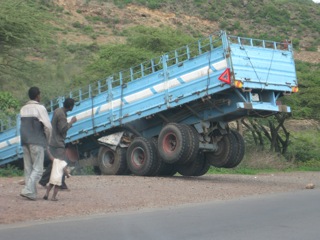
A common sight on the road to Nazret
I’ve been thinking a lot about a New York Times article from last November about land acquisition in Africa. At the time the article was published, I was nearing the end of a six-month stay in Ethiopia, where I was working for a Johns Hopkins affiliated NGO providing technical assistance to HIV/AIDS programs in the public hospitals. Though I spent much of my time in the office, I did get to make several work-related trips to Nazret, Ziway, and one of our satellite offices in Awassa.
Nazret is east of Addis Ababa, several hours along the road linking Addis to the Port of Djibouti. This road is heavily used by truck drivers carrying logs, oil and camels back and forth to the Port and is extremely dangerous for drivers. The trucks fly down the road at breakneck speeds, blasting melodic horns and stopping every few towns for the drivers to buy chat. I remember very little of the trip, since I spent most of the time with my eyes closed listening to (and feeling) the trucks whiz by our tiny Toyota filling the cab with dust and forcing us onto the shoulder to avoid being crushed, so I was excited to try a different trip outside Addis that would hopefully involve fewer brushes with death.
The road I took to Awassa follows the same route taken by New York Times author Andrew Rice when he wrote the piece I referenced earlier. My trip occurred in late November, and I was on the alert for any sign of the buy up of Ethiopian land by Middle Eastern companies that seemed so worrying in his article. I wasn’t disappointed: they were everywhere! All of a sudden the tef gave way to gigantic, shadecloth-covered greenhouses advertising melon and strawberry farms and “famous vineyards” of Southern Ethiopia (the propagation of these is particularly worrying: I’ve tried Ethiopian wine before – appropriately named “Gouder” – and can only describe it as a type of industrial cleaning solution that can strip the enamel off your teeth in one sip).
Having read Andrew Rice’s article and seeing all the greenhouses for myself, I started to get really annoyed. What did the Arabian companies think they were doing, coming into a developing country, buying up all the arable land and exporting the products without a thought to the local people? How could this be sustainable, especially in a place like Ethiopia that has a difficult enough time trying to feed its own population? Is it even meant to be sustainable?
It’s easy to take a situation like this and use it to get yourself worked up about the failure of development in Africa and the continued exploitation of weak nations to the benefit of rich ones, whether former colonial powers or emerging players on the development scene from the Middle East or Asia. I certainly felt this way for the duration of my trip to the South, and found it easy to keep myself worked up when I talked to my Ethiopian colleagues, none of whom liked the idea of foreign companies buying their farmland. I had a long discussion about this with one of the doctors from Awassa Hospital at breakfast one morning, where we took turns using a large stick to keep vervet monkeys away from our morning firfir. His main concern was the domination of cash crops in the South, and chat in particular. The demand for chat is growing across the Horn of Africa and brings in much more than growing other food crops like corn, tomatoes, beans or tef. Just as farmland is being lost to agribusiness companies from the Middle East, it is also being lost to huge chat farms, further decreasing the amount of land available for food crops.
I’m trying to be more open minded about development assistance, and understand that aid projects that seem damaging for developing nations may have benefits that aren’t immediately clear. Andrew Rice makes a good point when he says that foreign investors can bring in new technologies and boost the productivity of underused land to feed not only foreign investors but Africans as well (though the question that follows is whether foreign investors view subsistence farming as “underuse” of land).
I have a natural distrust of this kind of corporate-driven development aid, but I haven’t written it off entirely. It’s too soon to see whether investors have kept their promises to the Ethiopians, but it will be worth following up. If the investment companies are to be believed, agricultural development of “underused” African land could be the answer to world hunger. Whether this is true or not, I expect the strawberries, melons, and repulsive vintages of Southern Ethiopia to be around for quite a while.
