
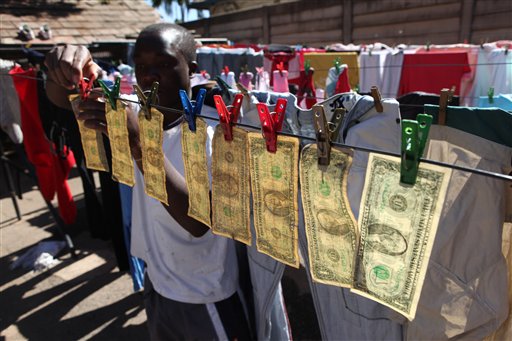
I had dinner last night with a friend who works for a large international development organization (which will go unnamed) here in D.C. This is her first job out of undergrad, and she was giving me a description of her first week, most of which involved sorting through resumes for several positions in the organization’s Zimbabwe office. My friend is an idealistic and optimistic person, but she started to cry as she told me about the resumes she read and mostly had to reject from the Zimbabwean applicants.
Everyone knows that Zimbabwe is in shambles economically. The coalition government declared several other countries’ money as legal tender last year in an effort to eradicate the inflation rate, which has topped a billion percent. Most often this money comes from neighboring Botswana (in Pula), South Africa (in Rand) or in U.S. dollars. U.S. dollars have become so valuable in Zimbabwe that people carry them in their shoes and underwear for safety and wash them over and over in order to keep them viable. This stands in stark contrast to the nearby Democratic Republic of the Congo (DRC), where U.S. dollars have no value at all unless they are freshly pressed and completely without blemish (read TexasInAfrica’s excellent post about this).
The unemployment rate in Zimbabwe is over 90%, and all who are lucky enough to have jobs are struggling to keep them.
My friend received a beautifully written email from a woman named Margaret who has worked with the aid organization for several months as a consultant and whose commission is ending this summer. Margaret was requesting a job as an office assistant in the main office in Harare when her commission expired, even though she is vastly overqualified for the job, just to keep her employed. My friend had to turn her down because the organization shares an office with another aid group that already has an office assistant. After Margaret’s email, the resumes got sadder and sadder:
“15 years of experience with farm development and livestock”
“Graduate degree from University in South Africa”
“Masters degree in agricultural development in Kenya”
All rejected because they had no experience with the USAID grant process. More painful were the resumes of people looking for entry-level jobs with the organization, all of which exude the happy, hard-working and friendly attitude of the Zimbabwean people:
“Pizza salesman: helped entertain customers when pizzas were late. Assured pizzas were delivered on time. Assisted in quality control of pizzas”
“Hobbies include assisting neighbors”
“Churchgoing Christian with two children, non-smoker”
“A great desire to help my country become Africa’s breadbasket once again”
“Fled to South Africa but would be willing to relocate home”
Small wonder my friend was miserable by the end of her week. “I’m 23!” she said, “what right do I have to decide whether a well-educated 55 year-old with two kids can have a job or not? I’m never working in recruitment ever again.”
The lack of USAID grant experience was particularly painful to hear. I know the USAID grant writing process, and while it can be insanely complicated at times, it’s not difficult to learn. It seems to me that relevant experience in a specialized sector and being a citizen of the country (hello language skills) would be more important in finding an in-country employee than experience with USAID, and the grant writing could always be outsourced to people like my friend, who are learning the process anyway.
By this point in the conversation my friend and I were deeply depressed and doing what any good white Africans do when they are unhappy and ordering another beer. I remember visiting Zimbabwe when it was still Africa’s breadbasket: the streets were impeccably clean, everyone was friendly and welcoming, and the Zimbabwean dollar was valued on par with the American. It’s horrible to see how badly the Zimbabweans want to fix their country and be reminded that they have no power to do so.
As you read, listen to this song from the South African singer Yvonne Chaka Chaka about the commute from Soweto to her job in Johannesburg during apartheid: http://www.youtube.com/watch?v=CW8xMHqt5i0
I really hope Margaret finds a job.
