
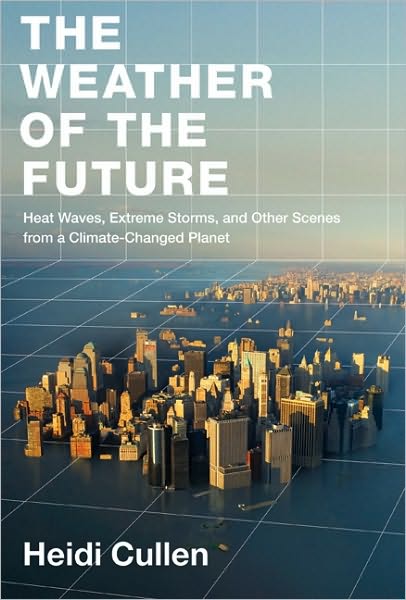
I wanted to flag two new books to you and a review of them. The first is The Weather of the Future: Heat Waves, Extreme Storms, and Other Scenes from a Climate-Changed Planet by Heidi Cullen and the second is The Climate War: True Believers, Power Brokers, and the Eleventh-Hour Fight to Save the Earth by Eric Pooley. Both writers are well and truly versed in their particular areas of inquiry: Cullen on the science and impacts of climate change, Pooley on the politics.
I wrote here about Cullen’s efforts to have the American Meteorological Society withhold its certification from those who “…can’t speak to the fundamental science…” of climate change. She is the CEO and Director of Communications of Climate Central, formerly the climate expert at the Weather Channel, and a climate scientist in her own right.
Michiko Kakutani’s review of both books the other day in the NYT describes The Weather of the Future thus: “Ms. Cullen grounds her harrowing predictions – extrapolations, really – in ‘the best available science’ derived from an array of climate models, environmental data and interviews with scientists.” We are clearly farther along the path of the climate catastrophe that Elizabeth Kolbert described in her landmark book, and things look more difficult than they did from the perspective of the IPCC’s sobering Fourth Assessment Report. In fact, one conclusion of a major international climate science conference two years after the AR4 was that “Recent observations show that greenhouse gas emissions and many aspects of the climate are changing near the upper boundary of the IPCC range of projections. Many key climate indicators are already moving beyond the patterns of natural variability within which contemporary society and economy have developed and thrived.”
This is Dr. Cullen’s message. (I will be reading the book itself and reviewing it in the not-too-distant future.)
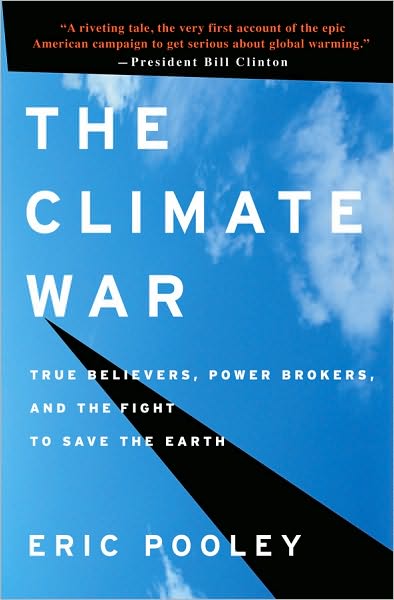
Another key message from the science conference of March, 2009 was that “inaction is inexcusable.” (See the Synthesis Report from “Climate Change: Global Risks, Challenges and Decisions.”) Inaction – most egregiously in the US Senate – is precisely what Eric Pooley is writing about in The Climate War. His story does focus on the considerable action that has taken place to try to get climate legislation written into federal law in the United States. But even with the best intentions of many people working very hard to effect change, the Senate has remained the roadblock.
Kakutani’s review quotes from the book: “In their least guarded moments, the climate campaigners would tell you what they had always known in their bones: their work was necessary but not sufficient. Climate action was going to happen sooner or later, but they couldn’t make it happen.” I have written any number of times about the conundrum that is the US Senate, most recently here.
Pooley gives us a crucial look at the context which will hopefully better inform our ability to overcome this damnable, pernicious and “inexcusable” inaction.
