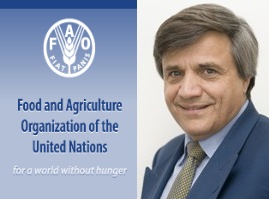
 Dr. Kostas Stamoulis is the Director of the Agricultural Development Economics Division of the UN’s Food and Agricultural Organization (FAO).
Dr. Stamoulis’s department produces the annual FAO publication, “The State of Food Insecurity in the World,” whose most recent edition, to be published in October, will indicate that the number of hungry people around the world has decreased from 1.023 billion in 2009 to 925 million in 2010.
A PhD in Agricultural and Resource Economics from the University of California at Berkeley, Dr. Stamoulis most recently taught Agricultural Economics at the University of Illinois in Urbana-Champaign.
—–
[FPA Q1.] With the next edition of “The State of Food Insecurity in the World” announcing a decrease in the overall number of hungry people around the world, does this indicate that the fight against global hunger is moving in the right direction, or are these results only a short-term gain?
[KS] First of all, any kind of reduction in world hunger is welcome news. However, the improvements that we see in 2010 are due to the reversal of a previous crisis. Actually I should say two crises, one on the heels of the other. One had to do with the high price of food, the explosion of food prices in 2007-2008, and then last year’s economic crisis.
So as food prices have declined substantially and certainly way below their peak levels of 2008, and the outlook on economic growth in developing countries looks positive this year, the improvements are due to the reversals of these extraordinary crises. The structural problem of hunger remains. As a matter of fact, we have actually witnessed an increase in the number of hungry people relative to the numbers before the crisis.
So, yes, it is welcome news but I’m afraid we are looking at a short-term gain. But that does not mean we cannot make long-term gains in the future.
[FPA Q2.] Do you find it more difficult to raise the necessary funding and/or awareness about global hunger in years when hunger numbers actually decrease?
[KS] Let me first highlight the facts –hunger in terms of the number of undernourished has been increasing since 1995 or 1996, right until today. And for a long period of time, we were trying to carry the point forward to the world community and the development community that hunger was decreasing. However, this did not necessarily result in a big change in terms of the development assistance and also country-level funding to agriculture and rural development, and FAO’s budget has been reduced several times in the past.
It is very difficult to say whether the trend of hunger over a period of time can determine greater awareness and more funding. Possibly awareness, but not necessarily funding.
So it is very difficult to answer this question. On the other hand, I would have to say that the huge increase in hunger to more than a billion people, accompanied with the bad news regarding food prices, got the world worrying about what is happening to agriculture and the future of global food supplies. This has attracted a lot more attention to the issue of agriculture and also to hunger. Hunger became the main item in the G8 agenda, global publicity for agriculture and food security was announced in the June 2008 conference in Rome, etc. So we have a number of expressions of concern for the hungry people in the world on the occasion of the high food prices which intensified as the number of hungry people reached over 1 billion as a result of high food prices and of the effects of economic crisis. I think that there was a world-wide concern about a generalized, long-term sharp increase in the prices of food, fiber and fuel and that certainly attracted quite a bit of press.
[FPA Q3.] In the past year, 10 countries achieved the first Millennium Development Goal (MDG) of halving poverty by 2015. Countries with large populations such as Brazil, China and Ethiopia are reportedly close to achieving this goal. Do you feel that the monitoring used for MDGs provides the best picture of how the goals are or are not being met? Is this recent success rate an indication that the first MDG will be met on time?
[KS] In terms of hunger reduction, we have to look at the some of the arithmetic. Today, we’ve made progress from about 20% to 16% of the world population being undernourished starting in 1990, so we are still some steps away from halving the share of hungry people, as requested by MDG1C.
With another five years or less to make six percentage points of progress, the arithmetic is against us. We made four percentage points in about nineteen years and we have less than five to progress by six. However, I’m not saying we should give up ground on MDG1 for hunger reduction just because the arithmetic doesn’t really bring us there. We have to do whatever it takes to achieve this goal. So my answer to this question depends on what we do differently today than what we did in the last nineteen years. The political commitment and resource mobilization has been insufficient so far. If it gets done now, we can meet the MDG1 on hunger.
Now, there is another issue that you raised in your questions. Of course, if some of the big countries experiencing significant economic growth also show a rapid reduction in the number of hungry people, we will make progress toward the goal. However, we should try to make sure that countries with high prevalence of hunger, whether they are small or big, also make progress toward the goal. We have seen progress in about a dozen countries that have achieved the goal, but we should look at those that are stagnant or actually reversing and we should try to analyze what the problems are in these countries. If we perceive the MDG as a global goal, global figures are the ones that are relevant but that is not enough. We should also aim for every country in the world to meet the Millennium Development Goal. This is the question to answer.
As a consequence, the monitoring of the MDGs has to be undertaken at all levels. We have to look at global progress, and go country by country to see who is making progress and who is not.
[FPA Q4.] The other chief publication of the FAO, “The State of Food and Agriculture” has focused its last three editions on the environmental impact of food production, looking at the impact of livestock (2009), biofuels (2008) and providing incentives for farmers using environmentally safe agricultural practices (2007). Does this show that the FAO recognizes the urgency for balancing environmental concerns and the fight against hunger?
[KS] We see the importance of reducing hunger in a way that is sustainable. We should not look at environmental issues and poverty reduction or hunger reduction issues as being necessarily a trade off. There are a lot of win-win situations. From our perspective, in some of the recent reports that you mentioned, for instance on biofuels, we suggested to improve the opportunities of poor farmers to participate in those new markets for biofuels feedstock.
Let’s looks at how we propose to do that. There are several ways to produce food and there are technologies out there which have a different environmental impact. When we support production in crops for food or livestock or feedstock for biofuels, we should provide the proper technology to farmers. So, of course we have environmental concerns. Of course we believe that production systems have to be sustainable, but that does not necessarily conflict with hunger reduction goals. It is a matter of how we propose to help in the fight against hunger in the ways that are most environmentally sustainable.
Extreme poverty and hunger themselves are a result and a cause of unsustainable practices. Slash-and-burn agriculture and other forms of unsustainable practices often times have the effect that people desperately seek to make a livelihood.
There are other kinds of environmental problems that have nothing to do with the poorest of the poor. Like overuse of certain inputs such as fertilizer or irrigation water. That is another part of the picture that needs to be addressed. But at this point, we are talking about the trade offs between environmentally friendly policies and the fight against hunger, and I am saying that these are not necessarily trade offs but complementary actions.
[FPA Q5.]. Does your department already have a theme for the next edition of “The State and Food and Agriculture” that you can share with us?
[KS] Of course. We are working on the theme of women in agriculture. We will publish that, hopefully this coming March, and it deals with the role of women in agriculture and their contribution, and how their contributions can be enhanced.
