
Larry Smith, a professor of geography at UCLA, recently came out with a book entitled “The World in 2050: Four Forces Shaping Civilization’s Northern Future.” On a Guggenheim Fellowship, Professor Smith traveled to the world’s northernmost reaches, visiting places ranging from a monastery in Russia to aboriginal villages in Northern Canada. He used technical computer models to evaluate how the world will look forty years from now. The Los Angeles Times reviewed his book favorably book here, as did the Wall Street Journal here. Professor Smith believes that indigenous people in the Far North will play an important role in decisions surrounding resource use in the Arctic by 2050. We’ve already seen this happening with multilateral organizations like the Arctic Council making sure to include indigenous peoples and groups, like the Inuit Circumpolar Conference, in their discussions. In an interview with the LA Times, Smith states:
“This means that the northern people are now stakeholders. From a human rights perspective, it’s great. From an environmental perspective, once the agreements are in place, aboriginal people will be able to favor resource development. Though the aboriginal people deeply care about the land and want to minimize damage. This is happening in Canada. But it’s not echoed in most of Europe and in Russia it’s bleak.”
Indeed, in the past couple of decades in Canada, aboriginal governments have settled a series of land claims with the federal government. Yet there is still a long way to go. Let’s not forget the outcry that happened back in February when Foreign Minister Lawrence Cannon failed to invite Canadian indigenous representatives to a conference with the Arctic Five held right before the G8 Summit.
While an undergraduate at UCLA, I took a remote sensing class with Professor Smith and also conducted independent research under his supervision on changes in sea level ice in the Arctic. He emphasized the importance of remote sensing and satellite imagery in the Arctic, as it provides informative, wide-ranging data on an otherwise hard-to-access area. In fact, the Northern Arctic Federal University (NARFU) in Arkhangelsk, Russia just opened the Space Monitoring Center of the Arctic on November 18 to monitor conditions in the Russian Arctic from space.
The Center (for which the idea was only conceived one month ago) will use the UNIScan-36 system. Manufactured by the company ScanEx, UNIScan-36 is a ground station that receives images from satellites in space that cover the Russian Arctic region, namely Terra/Aqua, EROS B, RADARSAT -1/-2, and SPOT 5. The variety of satellite data available to UNIScan-36 means that NARFU will be able to access remotely-sensed imagery of water and land cover (important for issues such as sea ice and permafrost melt, respectively), along with high-resolution images from SPOT. The system also comes with servers and software to process the images. The receiving satellite antenna will be located on the roof of the educational building at NARFU.
At the opening ceremony, Vladimir Gershenzon, the General Director of ScanEx, said, “Satellite imagery is sometimes the only source of unbiased and updated information about the condition of the territories, especially of such remote and hard-to-reach as the Russian Arctic.”
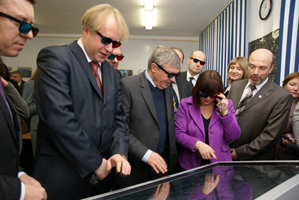
UNIScan-36 working its magic on ceremony attendees. Courtesy http://www.narfu.ru
News Articles
