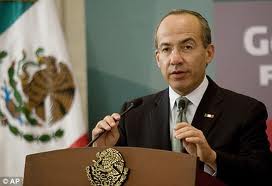
A very interesting juxtaposition in the news caught my eye this last week, thanks to WikiLeaks. I’m not praising WikiLeaks, mind you, merely pointing out that leaked cables revealed that the president of Mexico had been urging the U.S. to take a more active role in the region to counter belligerent actors in South America and unwelcome interference from those far from the Americas. According to this AP report:
Mexican President Felipe Calderon told a U.S. official last year that Latin America “needs a visible U.S. presence” to counter Venezuelan President Hugo Chavez’s growing influence in the region, according to a U.S. State Department cable leaked to WikiLeaks and posted online Thursday […] Calderon also said he was concerned about Venezuela’s ties to Iran, and that the Iranian Embassy in Mexico is very politically active. Calderon added that Iran’s influence is growing in the region thanks to Venezuela’s help, the memo said. Calderon also told Blair that there is a link among Iran, Venezuela, drug trafficking, and rule of law issues but the memo provides no details on that connection.
I’m struck by the irony (given our history) of the U.S. being asked to raise our profile in the Americas at a time when our presence has been greatly diminished. Thanks to past interventions, U.S. relations with our hemispheric neighbors now calls for careful diplomacy. The U.S. has been working quietly to build up regional institutions and although we have made some recent missteps, we have adopted a more collaborative and consultative approach that could easily be described as low-profile.
So, what did I mean by an interesting juxtaposition? As the media reported that President Calderon was suggesting that the U.S. step up to counter Venezuela and Iran the anniversary of the Monroe Doctrine passed by almost unnoticed. You will recall that the doctrine was promulgated by President James Monroe to counter European colonial influence in the Americas in the 19th Century. It basically said that this hemisphere was off-limits to foreign meddling. That began a long period of time in which the U.S. adopted a proprietary attitude toward our southern neighbors that wasn’t much appreciated. Which brings us back to the present. When our neighbor and ally Mexico warns us that Iran has increased their activity and influence in our backyard, how should the U.S. respond? Does the Monroe Doctrine still have relevance in the 21st Century?
Photo Credit: dailymail.co.uk
