
“A block of stone moving forward and leaving debris behind it”. 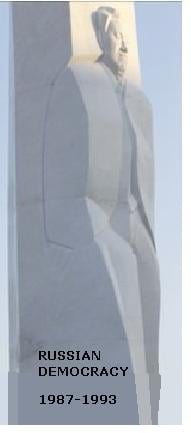
That’s how the sculptor behind Russia’s first post-Communist statue of a 20th century politician summed up his subject, Boris Yeltsin; and it’s probably the best description I’ve heard.
While grotesque, it’s not altogether senseless for the Kremlin to unveil a monument to Yeltsin a week after floating the idea of burying Lenin.
That’s because Yeltsin, born around the same time as Lenin was dying, shared more things with his opposite number than one might expect an erratic, anti-intellectual alcoholic right winger to share with a meticulous, ascetic and cerebral Communist mastermind.
Both were ruthless and pragmatic destroyers of previous worlds. Both advocated the creation of capitalism in Russia: Lenin in order to sweep up feudalism and prepare the country for socialism, and Yeltsin as an end in itself.
Most vividly, both were succeeded by proteges that went on to spectacularly undermine the projects they had laid down.
Have we been too hard on Yeltsin?
His daughter tells the BBC: “Looking back now, it might seem as if all the problems should have been easier to solve”.
She’s right. In hindsight, even the former supporters of privatisation have come round to the fact that it was a disaster, for example. But at the time, it was not at all clear what a successful formula was for the dying USSR. It’s easy to blame Yeltsin, but harder to think of how he could have acted differently at the time.
But I still maintain that we should blame Yeltsin, not because he failed to create a free, egalitarian and peaceful Russia, but because he didn’t even try.
Gorbachev’s tenure was in some ways even more disastrous, and his opinion ratings continue to testify that he is much more hated in Russia than Yeltsin.
Yet at least Gorbachev’s failures were the result of a Gramscian vision – poorly thought-through and even more poorly implemented – of the Soviet Union as a compassionate, democratic and humanistic heresy.
What was Yeltsin’s vision, apart from anti-communism and power-hunger?
Right wingers accuse him of capitulation: capitulating to Nato, to America, to the former republics. But his real, much more humiliating capitulation, was philosophical: that Russia would cease to be a laboratory, a heresy, or a blueprint. An otherwise notorious brawler, he gave up on Russia as an alternative world-historical project without a fight.
His most practical crime, however (aside from the genocidal subjugation of Chechnya) remains the destruction of democracy in Russia.
Even as archetypal a right-wing intellectual as Seymour Lipset understood that no democracy can function below a certain threshold of impoverishment, which Yeltsin’s policies created.
But quite aside from the tragic knock-on effects of shock therapy etc, Yeltsin was the only democrat who did not actually believe in democracy.
As his daughter admits:
At that time there were two camps – those who wanted democracy and freedom, and those who wanted to keep the totalitarian communist regime – and there were a lot of them.
Imagine what it was like for him trying to force through all these reforms against the will of these people who had a majority in parliament and a lot of influence on the government.
She’s right: let’s not be too hard on Yeltsin. Just imagine what it was like for him to force through all those reforms against the will of the people.
