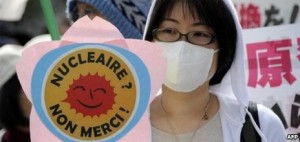
 The Japanese prime minister has caused something of a stir with his recent remark that perhaps Japan should end its reliance on nuclear power altogether, as Germany and Italy are in the process of doing. The obvious implications are in energy and climate policy, both national and global. But there’s also a more subtle military dimension, and there are implications for a world without weapons of mass destruction.
Japan has been firmly dedicated not only to current-generation nuclear reactors but also next-generation breeders, which depend entirely on reprocessing and recycling nuclear materials (breeders don’t “breed” unless plutonium is extracted from their blankets and recycled as fresh fuel). Yet both Japan’s breeder program and its reprocessing operations have been problem-plagued, and it has had to repeatedly push back commercialization targets. Following serious mishap in its prototype breeder reactor in December 1995 (by no means the only one), and after years of budget trimming, Japan now anticipates introducing breeders only in mid-centruy rather than in the 1980s, as originally foreseen. In another serious accident, at its major reprocessing plant in the late 1990s, workers died.
Considering Japan’s technical record, setbacks in all other breeder programs, and decisions by other major countries to give up on breeders entirely, why has Japan persisted with them? Contributing last year to a Princeton University fast breeder survey, Tatsujio Suzuki identified three possible reasons: organizational inertia; local economic incentives; and poor nuclear oversight.
But there’s a fourth he might have mentioned or speculated on: Because breeder reactors require reprocessing of nuclear fuels and likely involve handling of separated plutonium, they are desirable if a country wishes to position itself to build nuclear weapons rapidly, should the need for them suddenly arise. A ready supply of separated plutonium–Japan, of all non-nuclear-weapon states has by far the largest stockpile–would be convenient; and the ability to rapidly build that stockpile with high-grade breeder-bred plutonium could be portrayed as handy too. Though such connections are rarely stated openly in domestic political discussions–and in a country with a political culture like Japan’s it’s all the easier to to leave them unstated and undebated–this doesn’t mean they’re absent or unknown.
To see how this is so, it helps to take a big step backwards, to the years where the Nuclear Nonproliferation Treaty was negotiated and debated. At that time it was an open secret that the main purpose of and driving force behind the NPT was the desire to keep West Germany non-nuclear, which the Soviet Union, UK, USA, and France more or less equally shared. It also was no secret that in certain German circles, notably those around Franz Josef Strauss, leader of the Bavarian Christian Socialist Union, there was an urge to open the nuclear weapons option. (Occasionally reports would surface of informal discussions between German and French individuals about the possibility of a joint strategic deterrent.)
Though the NPT in principle allows all members in good standing full access to all civilian nuclear technology, Germany’s neighbors and allies found ways even after conclusion of the treaty to keep fuel cycles facilities–the facilities that can also produce weapons material–out of its hands. Germany, though committed for decades to breeder development and (still today) to the reprocessing and recycling of spent nuclear fuels, gets almost all its reprocessing done in France. Though a German scientist was the principal inventor of the uranium enrichment centrifuge, German enrichment work was initially done by the multinational company URENCO at a plant in Netherlands (where by the way A.Q. Khan purloined the technology he brought back to Pakistan and then sold round the world). Only in 1985 did Germany open an enrichment plant, still under URENCO auspices, on its own soil, at Gronau near the Dutch border.
Germany, in contrast to Japan, has been put through and put itself through a process of searching self-examination in the post-war period. And so the considerations outlined here also have been no secret to those Germans most firmly dedicated to the principle of “never again.” For them–and this too has not had to be said–the surest way to guarantee their country will never be a nuclear weapons state is to see to it that it’s 100-percent non-nuclear. By the same logic,
a Japan that ended reliance on nuclear energy would be a country that not incidentally also gave up breeder plans and shut down fuel cycle facilities. Thus it would be a country that’s a non-nuclear-weapons state not only by treaty commitment but virtually by definition.
That in turn would have policy implications in the other Asian countries that still regard Japan warily, notably half-nuclear North Korea, South Korea–which also has been committed to fuel reprocessing and recycling–and of course China. A rock-solid non-nuclear Japan might ease the path to a comprehensive Korean settlement, for example, or enhance the likelihood of China’s joining in strategic nuclear arms reductions talks when the U.S. and Russian force levels approach those of the three other major weapons states, France, the UK, and China.
Ironically, at just the historical moment when the Axis of World War II has at last lost all present-day relevance, it may be that the three Axis powers, Germany, Italy and Japan, are firmly turning their backs on the atom. The nuclear club–which not coincidentally happens to consist of the five major World War II victor powers–increasingly seems a relic too, though at least the provisional legitimation of the club by the NPT may have helped stabilize relations to the point where probability of nuclear war involving any of them is generally felt to be very nearly zero. The nuclear-weapons states not so legitimized–Israel, Pakistan and India, North Korea–remain tinderboxes.
