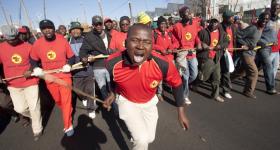
 Perhaps one should not read too much into the wave of strikes that seems to have taken over South Africa in recent weeks and led to what at least one observer has called “strike fever.” After all, one of the signs of South Africa’s vibrant civil society is the strength of its unions, especially given the prominent role that the Congress of South African Trade Unions (COSATU) plays in the country’s politics.
And yet because many of the strikes are aimed in part or in whole at industries either supported by or tied to the government, and given the sometimes fraught relationship between COSATU and the African National Congress (ANC), is it not possible that the strikes serve two functions? They both do what labor actions are built to do — raising the pay, benefits, and work conditions of union members — while at the same time serving as a nice reminder that COSATU, an organization that sometimes must feel like merely an appendage in the tripartite coalition, will not be trifled with.
By most definitions the ANC is, after all, the overwhelmingly dominant partner in the coalition. And because of that dominance COSATU and the South African Communist Party often feel constrained, second-class citizens rather than equal partners. What better way to flex one’s muscles under the guise of plausible denial than to send a loud and clear warning shot about COSATU’s ability to mobilize hundreds of thousands of workers across a range of essential sectors, including mining, metalworking, and fuel?
Again, I do not want to over-interpret the strikes. Workers have legitimate complaints and demands (and some less legitimate complaints and demands) and labor unions are nothing without leverage. And clearly recent settlements on the part of large swaths of the strikers indicates that the motivations really did stem first and foremost from a recognition of the demands of workers. But if this is just a coincidence it seems to me that it is quite a happy one from COSATU’s vantage point given the state of South African politics and the divisions in the ruling alliance. Zwelinzima Vavi, COSATU’s head, seems to have positioned himself quite well within the maelstrom that is South African politics. For all of the talk about Julius Malema and the ANC Youth League (and tensions between the Youth League and COSATU are themselves quite complex), I believe that Vavi represents perhaps the key figure not named Jacob Zuma going forward.
