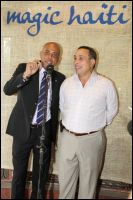
Pictures of the launch of Magic Haiti from Le Nouvelliste
“Shut up,” said President Michel Martelly to members of the national press who, in his view, kept tourists and potential investors at bay, depicting Haiti as a desolate, hostile environment. “Why don’t you just shut up,” he reportedly reiterated during a short speech at the initial launch of Magic Haiti, a magazine dedicated to promoting the country’s tourism. “The tourist or investor who would like to visit Haiti become hesitant listening to the news,” continued Martelly. “I don’t listen to them nor do I read them,” he told the crowd in attendance.
The event, organized by Le Nouvelliste, the oldest Haitian daily in partnership with the Touristic Association of Haiti (ATH), was part of Tourism Development Week scheduled from July 25 to 30, 2011. The initiative took the president on a national tour to meet actors and leaders of the industry, to share his visions as well as the role he would like the industry to play in reconstruction.
“Journalists are not the one saying bad things about Haiti,” replied Jacques Derosier, secretary general of the Association of Haitian Journalists (AJH). “It is the actors who reflect poorly on the country, painting a negative image of Haiti, and the journalists simply report the actions of those actors,” he added.
However, this tense relationship between the President and the media did not surface during his national tour. In fact, sporadic flares have been bubbling to the surface since the presidential campaign when an aggressive Haïtian press, highly critical of then candidate Martelly, questioned his moral, ethical and intellectual integrity to head the highest office. “Let him bring it on,” the then candidate warned Goston Pierre, editor and journalist of the online news organization AlterPress, during a debate with former First Lady candidate Mirlande Manigat. “They sent him to attack me! I’m ready for them and the people can see it too,” he cautioned.
Pierre provoked the reaction from the candidate when he repeatedly cited a Miami Herald article that revealed Martelly lost three Florida homes in the sub-prime mortgage crisis that swept through the United States and much of the world. According to the debate’s organizers, the journalists and both candidates agreed that, for the sake of fairness, questions that could not be asked of both candidates were not allowed. Organizers even issued an apology to Martelly after the debate for failing to prevent the line of questioning.
It was nonetheless, the latest episode that set the national press ablaze, denouncing the President’s complete disregard for Article 28 of the Haitian Constitution. “Journalists shall freely exercise their profession within the framework of the law. Such exercises may not be subject to any authorization or censorship, except in the case of war,” declared article 28.1.
However, the Haitian media does not enjoy the robust protection of First Amendment Rights as their counterparts in the United States do. Landmark cases such as New York Time vs. Sullivan, a cornerstone in the freedom of the American Press would never make it pass article 28.3 of the Haitian Constitution that stipulates, “All offenses involving the press and abuses of the right of expression come under the code of criminal law.” Actual malice, which puts the burden of proof on accusers in the U.S., is virtually nonexistent to Haitian reporters, empowering anyone with

Pictures of the launch of Magic Haiti from Le Nouvellist
some authority and a little motivation to conspire and destroy the spirit of article 28.1, journalists’ individual rights with it. Therefore, the tidal wave of media concern and complaints caused by President Martelly’s sobering statements were not misplaced or exaggerated. The national press, fully aware of the blurry line between warnings from government officials and human rights violations in Haiti, made a huge splash, rejecting the president’s premise.
Derosier asserted, “They were a direct assault on freedom of the press.” He called Martelly’s media relations communication counter-productive and urged journalists to maintain their professionalism and resist such intimidation tactics. “Freedom of the press is not given freely,” he said, reminding his colleagues, “It is rather earned through tough challenges and major sacrifices,” according to Le Nouvelliste.
Tensions escalated further during President Martelly’s tour. News organizations cataloged several incidents taken place between attending journalists and members of the president’s security detail, prompting a meeting between the Head of State and reporters.
As several news reports indicated, Martelly’s security personnel forced journalists waiting on the President in the lobby of hotel Cap Lamandou to vacate the area. Reporters were covering a president’s meeting with hotel managers of Jacmel, historic city in Southeastern Haiti known for its pristine beaches and tourist attractions. Some journalists, according to the Agency of Haitian Press (AHP), ran from what they characterized as threatening acts from security agents, leaving their equipment behind. As a result, the South Eastern Association of Journalists (AJSE) decided to boycott the president’s visit, actions that forced President Martelly to them in a meeting where he apologized to them for the ill-advise behavior of his agents and provided details about his visit to the region.
The Jacmel incident was not an isolated case, though. Journalists faced similar situations all along the president’s itinerary. Some reporters had their equipment confiscated and, in some instances, destroyed by agents while the President visited a super market consumed by fire in Gonaives, a coastal city also known as the capital of the Artibonite Department, located about 93 miles north of Port-au-Prince. Earlier that week, Associations of Northern Journalists protested the behavior of those agents, who reportedly shoved and push them, rather violently, during Martelly’s visit in Cap-Haitien, the country’s second largest city.
“Enough is enough,” released Haitian Writer, Poet and Journalist Nancy Roc of Radio Metropole. “The intolerance towards the press from both the executive and on the part of mickyistes has become totally unacceptable,” she added. She admitted journalists were not blameless, but argued they made great sacrifices to keep the population informed, sometimes risking their own lives and families in the process.
The latest developments preoccupied not only Roc, but also caused leaders and think tanks alike to raise their eyebrows at the pervasive and increasingly hostile tone His Excellency and his entourage directed at the media.
“Martelly’s statements are typical for presidents and regimes with little to show to a demanding population that is growing impatient,” said Daly Valet, general manager of the second oldest Haitian newspaper, Le Matin. Valet, who also writes editorials for the weekly paper and host radio show Vision 2000 a l’Ecoute, did not shy away from expressing his frustrations, reasoning that the news media was always instrumental in such situations to elicit understanding. “Unfortunately,” noted Valet, “Martelly seems more about business as usual, rather than a rupture.”
For his part, the director of Radio Scoop FM and host of popular radio show Haiti Debate, Gary Pierre-Paul Charles, was explicit in his remarks: “The Haitian press will not shut up,” he said armed with his microphone. “Because it offers the people a platform for the redressing of its grievances,” he explained.
As a rattled Haitian press flooded the atmosphere with complaints and outrage, the most poignant remarks came from some analysts who contextualized the Tourism Development Week. The media that was supposed to report on the President’s tour and help revive the tourism industry, they reasoned, forcibly wrote about drama and conflicts with the President and his personnel; hence, sucking needed oxygen from a momentous initiative perceived by President Martelly as a sustainable revenue stream for the country’s long-term development.
