
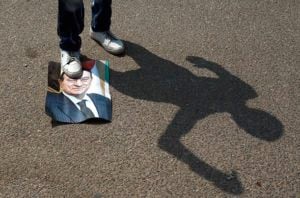
Asmaa Waguih / Reuters
In a historic televised event, former Egyptian President Hosni Mubarak appeared in his own court, facing hundreds of lawyers defending Egyptian protesters who helped oust the dictator from decades of unabated power. Yet is the trial an expression of justice, or a show, symbolic perhaps only in image?
Mubarak has been charged with corruption, and along with his sons, the responsibility of hundreds of protestors’ deaths during February’s monumental uprisings. On August 3rd, the first day of the trial, throngs of Egyptians had the chance to see their embattled former dictator behind bars, subject to a civilian trial- an extraordinary means of catharsis and retribution. When judge Ahmed Rifaat ordered the cameras to be turned off on the second day, in order to “protect the public interest,” the crowds reeled. The trial will now be suspended until September 5th, and combined with that of former Interior Minster Habib al-Adly, who is believed to have been implicate in Mubarak’s crimes.
One impediment to the proceedings, according to the judge, was the presence of more than one hundred lawyers, all arguably vying for credit, or television spots, in the historical trial. Without cameras, and the circus they bring, legitimate prosecution lawyers will arguably be able to more effectively argue their cases. As one lawyer told the Associated Press, “This will give us the right to some clam and concentration and turn it again into a legal case, not a show.” Yet some protesters argue that the decision to conduct the trail in private removes the crucial element of the public’s participation, and could signal a deal between Mubarak and prosecutors or the judge.
Indeed, the military leadership trying their former commander raises some key issues. Mubarak’s lawyer has asked the incumbent military head, Field Marshal Mohamad Hussain Tantawi to testify, in an attempt to link the current administration with Mubarak’s crimes. In light of recent protests calling into question “reforms” since the overthrow of the dictator, the military’s perceived independence in the trial will be crucial.
Also at stake is the image the trial has presented to the public. New York Times journalist David Kirkpatrick commented on the tradition of caging opponents in Egyptian trials- a measure that immediately denotes a level of guilt. The sight of 83-year-old Mubarak, in a hospital bed, behind bars, was jarring to say the least. BBC News reports of the mixed response amongst the public to the image of the formidable leader- noting that many were “as stunned as they were delighted.” One political cartoonist depicted Mubarak in the hospital bed flanked by camera lights; his lawyer says from a director’s chair, “Good, now is the time to play the victim.”
Political Science professor Nathan Brown offers a good analysis of the “Egyptianess” of the trail; a fact he argues many American news outlets have ignored when reporting on the oddities of the prosecution. Yet the fact that it is a true Egyptian trial means it has many inherent problems. As Brown writes, “The former president’s case appears to be fast-tracked because of political pressure. This fact is unfortunate in itself — but also worrying because it risks obscuring how much the system is overwhelmed with the mountains of corruption the old system was built upon.”
After so much show and no results, it seems clear that the current administration aims to drag out the trial as much as possible. While the image of Mubarak, once a feared, even revered leader, listening to his crimes behind bars from a hospital bed is monumental- for Egyptians, the Arab world, and even the millions in the U.S. following the ongoing revolution- is it anything more than that, an image? Clearly pictures are crucial in their own right, but only time will tell if the trial lives up to the significance many have attributed to it.
On August 15th, violent clashes persisted outside the courtroom. Hisham Kassem, a prominent opposition media mogul, reported to Time Magazine, “Mubarak’s regime has been undermined, but it has not been eliminated. And I think Egypt will need to have another revolution before that regime is completely eliminated.”
