After the collapse of the USSR, Moldova emerged as a fragile state, burdened by weak institutions and deep socio-economic crises. The 1992 armed conflict in Transnistria further exposed these vulnerabilities. Although the conflict was frozen, for over three decades, it has remained an inseparable part of Moldova’s political landscape.
Moldova today is not merely a small post-Soviet republic. Situated between Romania and Ukraine, it lies at the intersection of EU and Russian spheres of influence. For this reason, every election and political decision attracts serious attention, both regionally and internationally.
European leaders — German Chancellor Friedrich Merz, French President Emmanuel Macron, and European Commission President Ursula von der Leyen — broke diplomatic protocol by traveling directly to Chișinău to openly endorse President Maia Sandu’s Party of Action and Solidarity (PAS).
Their message was clear: if Moldova embarks on the path of EU accession, it will enjoy economic growth and even find solutions to the Transnistrian conflict.
Yet this approach has sparked controversy. Opposition figures argue that open support from EU leaders disrupts electoral balance and undermines the legitimacy of the ruling party.
During the Biden administration, Moldova received millions of dollars in U.S. assistance, some of which had originally been earmarked for Ukraine. Former USAID Administrator Samantha Power stated bluntly: “We gave Moldova unprecedented support; we expanded USAID programs significantly.”
But the new administration — represented by Vice President JD Vance and Secretary of State Marco Rubio — has sharply criticized this policy. In their view, if a nation’s democracy depends on foreign money, then it was never strong to begin with.
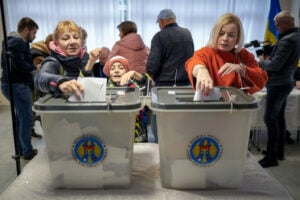
The United States is now shifting toward a more distant stance, leaving Moldova’s future more in the hands of the European Union. As elections approach, Sandu’s government faces serious accusations: pressure on opposition figures, closure of independent media outlets, and restrictions on access to polling stations.
Opposition leader Ion Ceban, mayor of Chișinău, stated bluntly: “They are holding the country hostage. They tell us: if you don’t support us, war in Transnistria may flare up again.”
The government denies these charges, insisting all measures comply with Moldovan law. Yet the pre-election climate is far from democratic standards. Former Israeli Communication Minister Ayoob Kara has assessed the Moldovan situation as follows: “Democracy cannot be sustained merely through pressure from Brussels or Washington; it must be strengthened by the free will of Moldova’s citizens. When foreign interventions distort electoral balance, public trust erodes. What we truly need are equal conditions, free media, and every citizen’s ability to express their vote freely.”
His statement underscores three critical points:
Kara’s remarks highlight that while international actors shape the playing field, genuine democracy depends on the people themselves. Moldova may be small, but it has become a symbolic battleground in the global struggle for influence.
For the EU: Moldova is meant to be a success story of European integration. For the U.S, the new administration prefers distance, but for Donald Trump, resolving the Transnistrian issue could represent a major diplomatic achievement — perhaps even strengthening his case for the Nobel Peace Prize.
As Vice President JD Vance put it: “If your democracy can be destroyed by a few hundred thousand dollars in foreign advertising, then it wasn’t very strong to begin with.”
These words echo Kara’s perspective: one from the outside, the other from within the region, but both pointing to the same truth — real democracy can only be built on the will of the people and the strength of domestic institutions.
The Moldovan elections provide three key lessons:
Moldova’s elections are not just about one small country’s domestic politics — they are also a critical test of whether the West’s model of democracy promotion will succeed or fail.
