
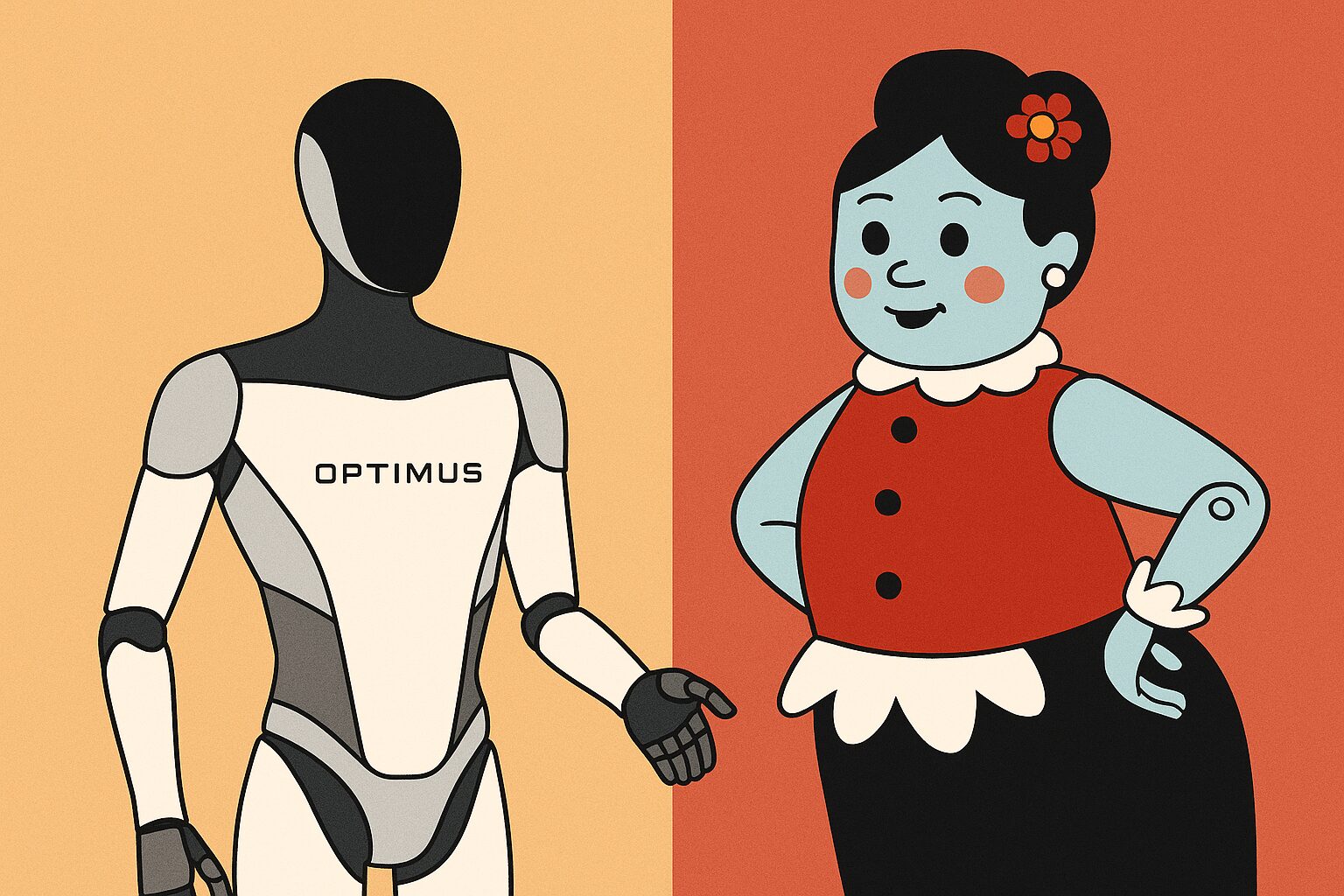
On May 21st, 2025, Tesla dropped its most impressive humanoid robot demo yet—a slick video of its Optimus robot cooking dinner, folding laundry, and taking out the trash. It wasn’t just choreography this time. The robot moved with coordination, handled tools with finesse, and followed natural language instructions—sparking online comparisons to “Rosie” from The Jetsons, the 1960s cartoon housekeeper who could do it all.
But while American audiences were still replaying the demo, across the Pacific, a different robotic future was quietly taking shape. Backed by strategic state funding and a relentless manufacturing machine, Chinese firms have been scaling up their own humanoid robots—less flashy, perhaps, but increasingly functional. And cheaper.
The question looms: Is Tesla about to deliver the first real Rosie? Or will China’s mass-market “Red Rosie” quietly win the race to your living room?
Tesla’s latest version of Optimus marks a stark evolution from its earlier dance-floor debut. In this newest release, the robot is shown preparing food, loading a dishwasher, and cleaning up—a transition from gimmick to genuine utility.
The leap forward lies in how it learns. Optimus can now observe third-person videos online, interpret them using computer vision and large language models, and reproduce tasks in physical space. Instead of needing line-by-line coding, it learns by watching—much like humans do.
Tesla says this model is being trained for a wide variety of applications, domestic and industrial alike. Elon Musk claims Optimus will enter mass production by 2030, with a target price of around $20,000 per unit, and ambitions for up to 1 million units per year.
It’s still early-stage—there are no retail units, no delivery timelines—but Optimus now looks less like science fiction, and more like a near-future consumer appliance.
While Tesla’s Optimus captures headlines and likes, Chinese robotics firms are quietly building something more pragmatic: general-purpose service robots optimized for cost, volume, and immediate use.
China is already the world leader in industrial robot deployment, commanding over 50% of global installations. But in the last three years, its domestic firms have moved aggressively into humanoid and service robotics—deploying robots into hospitals, hotels, warehouses, and nursing homes.
Companies like Fourier Intelligence, UBTECH, and Unitree have each rolled out bipedal humanoids that can perform basic chores, support the elderly, or deliver goods in indoor settings. Some of these are already in commercial pilot use and priced below $10,000, made possible by China’s vast electronics supply chain and vertically integrated production ecosystems.
The difference isn’t just corporate—it’s strategic. China’s robot push is state-coordinated, part of national policy under the “Made in China 2025” initiative. Robotics R&D receives heavy subsidies, public-private partnerships accelerate prototyping, and domestic robot firms are given preferential access to procurement contracts.
It’s not about viral moments. It’s about building infrastructure.
The contrast reveals fundamentally different approaches to robotics development:
Tesla embodies Silicon Valley’s moonshot culture—bold technical leaps paired with viral marketing moments. Chinese firms follow a more methodical approach rooted in manufacturing pragmatism and coordinated state strategy.
Rosie from The Jetsons vacuumed floors, managed schedules, offered life advice, and kept the family sane. Today’s robots—Optimus included—are still bound by brittle generalization and narrow use cases. They can follow a recipe, but can’t yet adapt to a toddler running underfoot or an unexpected spill.
Technically, we’re on the verge of semi-autonomous domestic robots that perform specific household tasks—but only under controlled conditions. And they can’t yet feel, intuit, or comfort, which limits their value in caregiving or companionship.
So yes, Rosie is coming—but she’ll start out as a kitchen intern with limited mobility and zero sarcasm. Full-blown domestic androids with emotional intelligence? That’s still science fiction.
Tesla’s Optimus demonstrates what’s possible when cutting-edge AI, robotics engineering, and brand hype converge. But Chinese firms—state-backed, efficiency-optimized, and supply-chain fluent—may reach ordinary consumers faster.
Tesla might be the one to dream up Rosie. But China might just mass-produce her first.
The future of domestic robotics may not arrive with a viral video—but it may come stamped with “Made in China” and priced for mass adoption rather than headlines.
