
Several international and European human rights organizations along with hundreds of social media activists took part in a huge social media campaign in front of the European Parliament in an attempt to raise awareness regarding the human rights situation in Sudan and the use of chemical weapons against civilians following the report of France 24 ,the French channel together with a euronews report that showed members of EUB network which demonstrates the use of chemical weapons against civilians by the Sudanese Armed forces.
The media campaign in Europe comes as a continuous action to support the work of several human rights organizations which called upon the EU and international community to tell the Sudanese Armed forces to stop the use of chemical weapons and to call for ceasefire and peace as well as bring humanitarian aid to a suffering population.
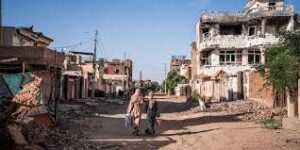
It is also an action to inform young people in Europe and beyond about this forgotten crisis which caused the death of more than 150,000 people, the famine of more than 25 million people and the displacement of more than 14 million people.
Andy Vermaut, journalist and human rights defender, regretted that “Egypt, our neighbor across the sands, has aligned itself with the Sudanese Armed Forces, offering support that sustains the cycle of violence—support driven by borders and waters shared, yet prolonging the very chaos that drives refugees to their doors, over two million strong, fleeing homes turned to ash.”
According to Vermaut, “Iran extends its reach, arming the army with drones and weapons that tear through communities—exporting turmoil to a land already scarred by division, where ambition overshadows aid. Turkey and Qatar, too, lend their hands—through arms, through influence—turning Sudan’s internal strife into a theater of international ambition, where the powerful play games and the powerless pay the price; where alliances meant for stability instead fuel the fires of destruction.”
Vermaut continued, “And then there are the weapons that haunt our collective conscience: reports of chemical agents, chlorine gas deployed by the Sudanese army against its own people—choking the air of hope in places like Khartoum, violating every principle of human decency, echoing the horrors of wars we vowed never to repeat.”
Sadaf Daneshizadeh, representative of “Prosperous Iran”, joined this campaign by highlighting that “The Sudanese conflict must be analyzed not only as an internal crisis, but also within the broader context of regional dynamics. Several external actors, including the Islamic Republic of Iran, appear to be playing an indirect but significant role, notably through military cooperation and the transfer of capabilities, such as drone systems. These interactions, even when presented as strictly bilateral or defensive, contribute to the prolongation of hostilities and the worsening of the humanitarian situation.”
Manel Msalmi, women’s rights advocate and human rights advisor at Milton Friedman Institute, mentioned the report of France 24 and stressed the fact that “We all share a joint duty to uphold the rights and dignity of every individual, regardless of their location. We must not choose silence in the face of inaction; rather, we should raise our voices and ensure that the plight of the Sudanese people is acknowledged. To advocate for and support the Sudanese population, it is crucial to stay updated on the circumstances. This report aims to draw the world’s attention on the swiftly changing situation, underline the dangers of a further decline, and stress the immediate actions that are necessary to avoid further escalation.”
All the participants called for an immediate action, a ceasefire and a peace plan which guarantees access to humanitarian aid, food and shelter and put an end to the huge displacement crisis.
