Electro vs. Petro? Think Synergy Beyond Energy!
Lately, pundits have increasingly relied on an ‘electro‑state vs. petro‑state’ frame to describe the post‑Iran-war energy–industrial realignment and its implications for the global economic order. Yet this framing is strategically flawed, because it implicitly treats green industries as the only viable evolutionary path to an ‘electro’ industrial revolution while overlooking how so‑called ‘petro’ industries could synergistically reinforce U.S. technological dominance over China in AI and other emerging technological industries. This kind of bipolarization contentiously balkanizes the industrial landscape along rigid partisan lines, preventing the emergence of integrated, bipartisan consortia that could otherwise leverage the synergistic complementarities between U.S. resource wealth and its advanced information technology. Furthermore, this fragmented industrial discourse creates a strategic opening for Beijing to leverage a green neoliberal alignment between its partisan directives and the post-Marxist critiques inherent in European continental thoughts, maneuvering radical environmental activists to function as the conduits for China’s state-centric industrial standards.
Thus, what is needed instead, for U.S. energy-industrial leadership around the globe, especially in the Indo-Pacific, is a new grand strategy that builds momentum for a comprehensive industrial ecosystem of resources and information technology. Initially supported by state-backed market mechanisms to ensure supply-chain reliability and stable demand for critical minerals and maritime logistics, this type of institutional arrangement would gradually evolve toward long-term governance goals enhancing the shared values of the U.S. and its alliances around the globe.
A compelling roadmap for this strategy lies in the formation of a club-based, necessarily quasi-wartime economic network of “Marine-tech States” destined to evolve into a Blue Economy infrastructure-governance regime. This transition, inspired by the Fourth Industrial Revolution yet distinguished by a sharp domain awareness, hinges on the burgeoning cross-sectoral synergy between unlikely partners—specifically the fusion of Big Oil’s physical assets with Big Tech’s computational power.
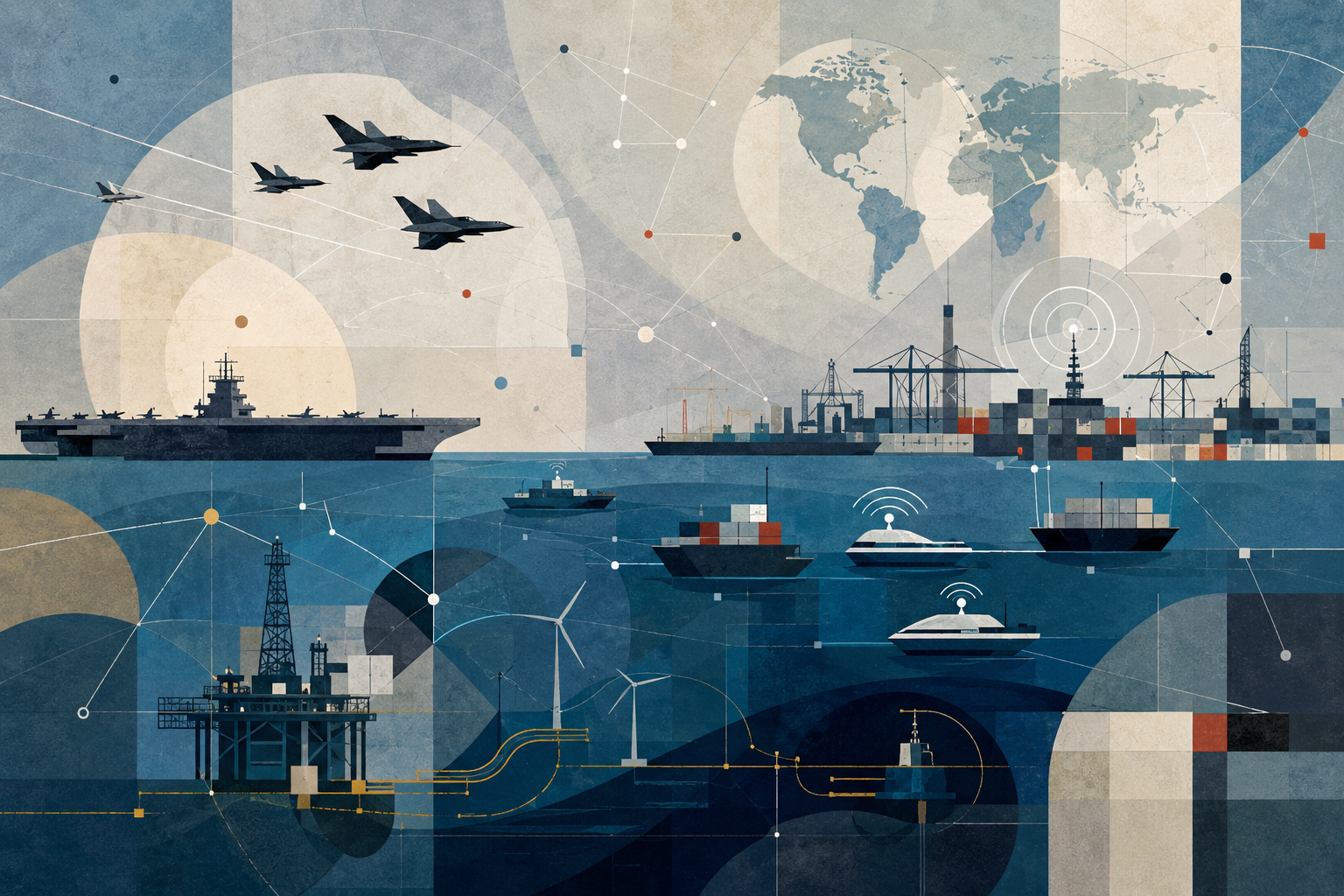
For example, the convergence of deep-sea oil/gas extraction, offshore wind energy, and autonomous maritime navigation creates a self-reinforcing loop of energy and intelligence. In this model, shared power grids and AI-driven edge-computing networks transform disparate sea-based sectors into a singular, high-productivity AI-integrated tech-complex. Here, real-time data fusion optimizes energy distribution and fleet logistics with unprecedented efficiency, turning vast maritime territories into a programmable industrial platform.
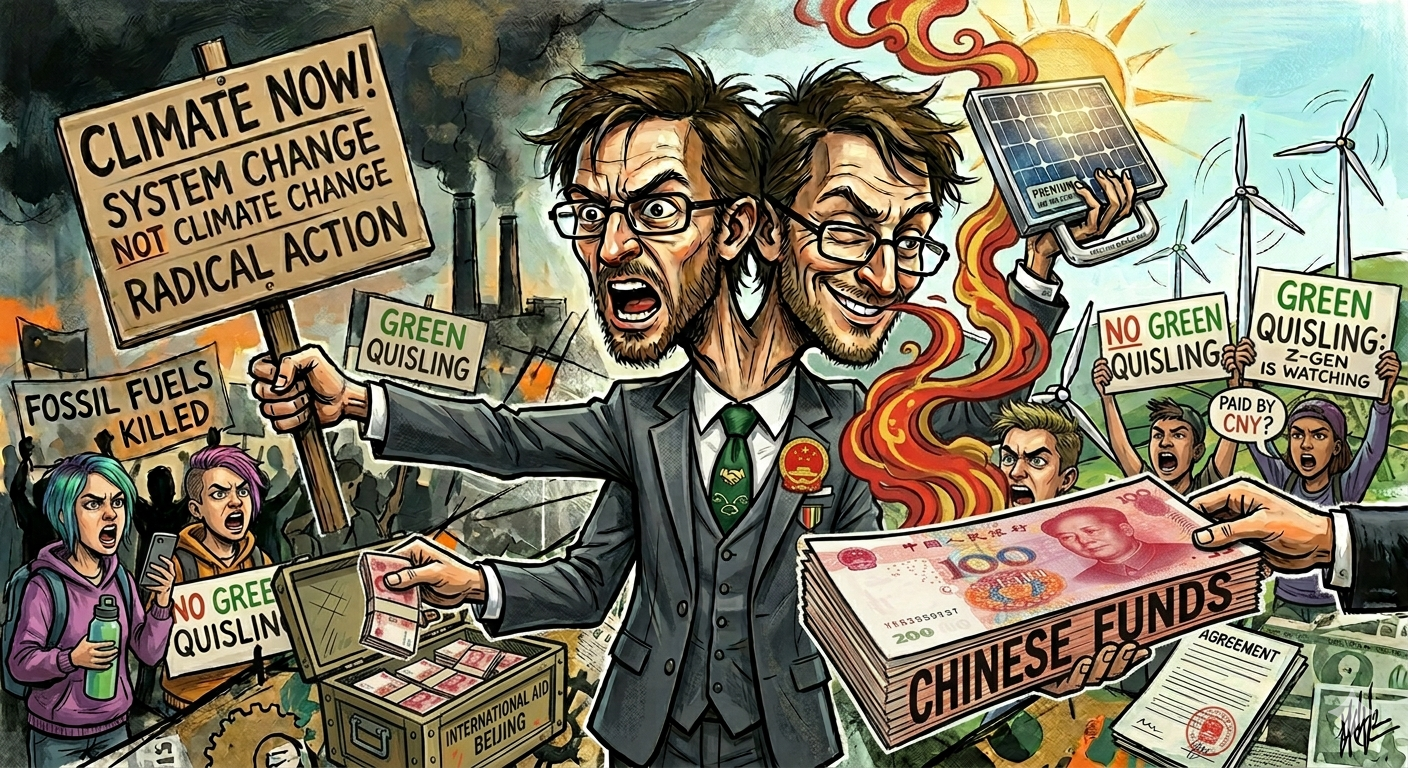
Green Commercial Plank Hands China Advantage, Fuels ‘Red-Green’ Quislings
Under the 14th Five-Year Plan (2021–2025), China’s ‘New Three’ industries—Electric Vehicles (EVs), Lithium-ion batteries, and Solar PVs—have been strategically weaponized as the material bedrock of the CCP’s ‘Green Legitimacy.’ More precisely, driven by the state-sponsored, export-oriented doctrine of ‘Ecological Civilization,’ Beijing has successfully institutionalized systemic overproduction of the New Three as the ultimate manifestation of ‘Green Development with Chinese Characteristics.’ By 2025, this ‘Red-Green’ growth engine became the CCP’s indispensable shield against a crippling domestic property crisis. In green energy, exports of lithium batteries (26.2%) and wind turbines (48.7%) soared, while green mobility saw electric motorcycles and bicycles rise by 18.1%. Collectively, China’s high-tech exports reached 5.25 trillion yuan in 2025—a 13.2% year-on-year increase. These figures confirm a strategic pivot: Beijing is now securing its survival by offloading industrial overcapacity into the global market.
Such success stems not only from domestic mobilization but also from a calculated global offensive. To ensure an international environment hospitable to such expansion, China has systematically abused the diplomatic ruse of ‘seeking common ground while reserving differences.’ Since pivoting decisively from the 2009 Copenhagen COP15, Beijing has deployed this constructivist green-politics rhetoric to strategically foreclose bilateral climate cooperation with the United States—redirecting the global agenda instead toward a multipolarized, winner-takes-all developmental path. China has now driven this constructivist Green Neoliberalism to its terminal stage, as it dominates the overproduction of the New Three.
What makes this stage truly terminal, however, is not Beijing’s external pressure alone. It is the structural erosion of the West’s internal integrity and will to resist — a decay cultivated by the treachery of post-Copenhagen green radicals.
The historical parallel is instructive. Just as the radical syndicates of the 1980s emerged as an organic counterforce to Reaganomics, monopolizing the reactionary space before entering the mainstream via the ‘Third Way’ compromise, today’s ‘Green Quislings’ have perfected that very trajectory. Having traded their radical roots for parliamentary seats and NGO leadership throughout the 1990s and 2000s, these actors are now opportunistically riding the ‘Chinese Wave’ to consolidate institutional power. In doing so, they have structurally designed the green transition to absorb Beijing’s industrial output, converting environmental policy into an instrument of generational power succession and securing their sociopolitical interests through a self-perpetuating alignment with Chinese capital.
Such greedy pursuit of Chinese capital, buttressed by the ideological interoperability between radical European continental philosophies and Chinese communist ideals, has handed Beijing a decisive advantage. For Beijing, global climate policy becomes a cost-effective theater for multidimensional warfare, requiring little more than the strategic fueling of Western ideological divisions.
The strategic payoff is structural. By leveraging systemic overcapacity as a coercive instrument and rendering both green neoliberals and radicals politico-economically dependent on the mechanism, China secures an effective veto over Western energy autonomy. Indeed, with Chinese firms controlling more than 80% of Europe’s residential storage segment and nearly 88% of lithium-ion battery imports, China has converted clean-tech overcapacity into a strategic dependence that constrains Europe’s energy autonomy. The ultimate result is a new administrative establishment that consistently subordinates Western industrial integrity to a lucrative alignment with Beijing — a relationship that is no longer merely dependency, but capitulation by design.
Smart Ports as Hanseatic Kontors 2.0: U.S. Grand Strategy for Orchestrating Marine-Tech States and a New Maritime Order
In the contemporary landscape of global green politics, a U.S.-led alternative development governance framework centered on the Blue Economy is no longer merely an option—it has become a strategic imperative for dismantling China’s green monopoly. Just as Beijing weaponized the doctrine of “Ecological Civilization” as the ideological engine of continental hegemony, Washington must now mobilize the Blue Economy as the strategic foundation of a maritime economic-security complex in which the United States retains an inherent structural advantage.
Central to this grand strategy lies the emergence of Marine-Tech States: a trust-based constellation of like-minded sovereign powers engineered to sustain interoperable supply chains, resilient maritime infrastructure, and integrated industrial coordination. Rather than functioning as a conventional unilateral security bloc, this network represents a form of Minilateral Geoeconomic Orchestration—a self-reinforcing ecosystem in which strategic logistics, industrial production, and commercial governance become structurally synchronized.
Mirroring the historical logic of the Hanseatic League, the network restructures the regional economic-security nexus by embedding an Industrial Lock-in between the leading hegemon and its allied economies. Lübeck did not exercise dominance through brute coercion alone, but through the establishment of exclusive standards of interoperability within the Kontor system, rendering it economically untenable for member states to operate outside the Hansa framework. In much the same way, the United States anchors its allies through a modern form of Techno-Structural Synthesis.
On one level, this synthesis takes physical form through the Commercial Synergy Club—a high-tech successor to the medieval Hanseatic Kontors. The semi-autonomous hubs that once served as the League’s legal and logistical nerve centers are now reimagined as “Customs Circle Offices.” Embedded within every strategic Smart Port, these outposts function as sovereign technical nodes, combining the diplomatic legitimacy of a UN field office with the administrative authority of an Allied Maritime Port Authority (AMPA).
At another level, the AMPA operates as a sophisticated commercial interface that institutionalizes Stabilized Securitization under the broader strategic umbrella of allied naval power. Rather than relying on overt military intervention, security is embedded directly into the operational logic of trade itself as a premium administrative service—a kind of “Global EZ-Pass” for trusted commerce. The foundation of this system is reinforced through frameworks such as the Critical Mineral Summit and Pax Silica, which coordinate demand-and-supply mechanisms across trusted economies in order to preserve systemic resilience and reduce strategic dependency on vulnerable supply chains.
By fusing U.S. strategic assets—specifically SMR-driven energy systems, deep-sea petroleum extraction capabilities, and AI-integrated maritime operating systems—with the unrivaled industrial capacity of advanced allied economies, the network establishes a geopolitical foundation that is both technically and politically robust. Within this emerging order, the U.S. State Department defines the overarching standards of trust, interoperability, and transparency, while the AMPA preserves the integrity of that architecture through encrypted technical protocols and synchronized commercial governance.
In effect, this framework replaces the fragile idealism of carbon-neutral globalism with a stabilized and durable doctrine of Maritime Technological Sovereignty, generating a self-reinforcing Network Effect rooted in Stabilized Securitization. As gains in efficiency, predictability, and infrastructural trust elevate the Hanseatic Kontor 2.0 ecosystem into the preeminent gateway of global commerce, interoperability itself becomes the decisive source of strategic and commercial advantage. Rival powers are consequently confronted with a stark strategic choice: align with the Club’s architecture in order to capture these systemic dividends, or remain increasingly marginalized from the dominant flows of maritime trade, industrial coordination, and global wealth.
