
Will technology and financial engineering of complex products require the global coordination of a financial regulatory regime. More global finance and economic policy-makers think so.
Will technology and financial engineering of complex products require the global coordination of a financial regulatory regime. More global finance and economic policy-makers think so.

The Federal Reserve and the Treasury are preparing broad new rules that would force the financial industry to rein in excessive compensation schemes and commission practices that disproportionate made gazzillionaires at the expense of investors and taxpayers out of many financial executives – many just out of college – during the global financial meltdown.
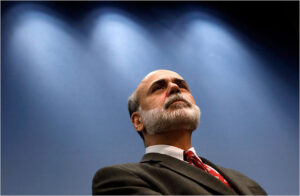
The Federal Reserve chairman, Ben S. Bernanke, speaking at a Brookings Institute Conference, said Tuesday that it was “very likely” that the recession had ended although he cautioned that it could be months before unemployment rates dropped significantly.

Pittsburgh, PA will host the next G-20 Summit slated for Thursday & Friday, September 24-25th, 2009. President Obama will chair this meeting of leaders from countries around the world who represent 85% of the global economy. At the Pittsburgh G-20 Summit, leaders will review the progress made since the London Summits, recent protectionist measures between the U.S and China over tires, auto parts and chicken exports, and discuss further actions to assure a sound and sustainable economic recovery from the global financial and economic crisis.
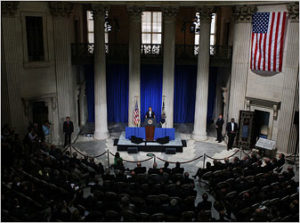
Mon, 14 Sept – President Obama reinvigorated his administration’s effort to reform the financial regulatory system by taking his bare knuckled message directly to Wall Street. Speaking at Federal Hall and using the one year anniversary of the Wall St. collapse the president reminded prominent financial industry executives of their role and risk-taking behavior that led to a global economic melt-down.
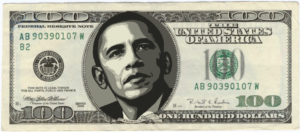
According to an article in today’s (2 Sept 2009) Wall Street Journal, Goldman Sachs’ Cheif U.S. Economist says that President Obama’s economic stimulus package is beginning to boost U.S. economic performance.
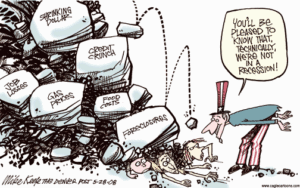
According to the most recent economic data released this week, the U.S. trade deficit in July hit the highest level in six months as a record rise in imports outpaced a third straight month’s increase in foreign demand for American products, according to government data released Thursday. This is a boon for the Obama recovery stimulus paln.

Banks and credit unions have long pitched debit cards as a convenient and prudent way to buy. But a growing number are now allowing consumers to exceed their balances — for a hefty, some say, abusive, fee. Banks market it as overdraft protection, and the fees it generates have become an important stream of revenue fees for the banking industry. This year alone, banks are expected to bring in $27 billion by covering overdrafts on checking accounts, typically on debit card purchases or checks that exceed a customer’s balance.
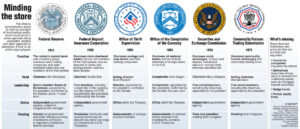
In a NY Times Op-Ed, Sheila Bair, Chair of the Federal Deposit Insurance Corporation (FDIC) outlines a compelling litany of reasons why the Obama administration’s proposed regulatory changes, while good in many respects, does not sufficiently address the issues that caused the current – or will prevent future – financial sector crises.
According to reports in both the Financial Times of London, as well as the New York Times, the Federal Reserve has made a $14Bn profit on TARP loan programs to struggling banks using tax-payer funds.
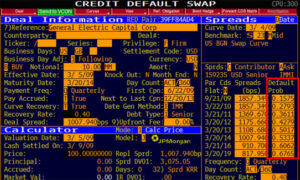
Interesting segment by 60 Minutes’ Steve Kroft, in which he walks viewers through the fundamentals of these financial WMDs called Credit Default Swaps which were the derivative products underlying the near collapse of the global financial markets.

Understanding U.S. Foreign Policy in the context of the nation’s changing demographic landscape, and a discussion of ‘Why Africa Matters’ by the Rev. Jesse L. Jackson.
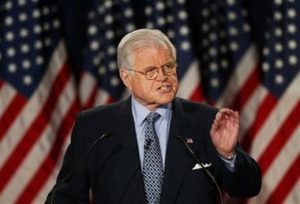
‘For all those whose cares have been our concern, the work goes on, the cause endures, the hope still lives and the dream shall never die.’
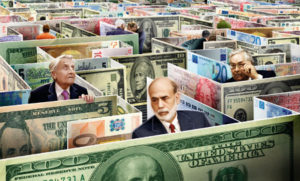
The world’s central bankers meeting for an annual Federal Reserve summer symposiun retreat say tougher regulatory reforms and oversight necessary for a full recovery, and agree to keep coordinated interest rates low to help boost global economic recovery.
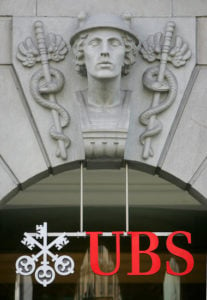
Switzerland’s government said Thursday that it was in the process of selling its stake in the giant bank U.B.S., a transaction that it expects will generate about one billion Swiss francs, or $938 million, in profit for taxpayers.