UPDATE: Violent protests continue to rock Egypt this week, with demonstrators demanding the ouster of the country’s longtime autocratic president, Hosni Mubarak. The tension increased today when Mohammed El-Baradei, a former top official at the UN’s nuclear watchdog agency and a high-profile Mubarak opponent, who had returned to Cairo in a bid to provide a […]
Standard & Poor’s, a leading credit ratings agency downgraded Japan’s long-term sovereign debt Thursday, a sharp reminder of the heavy financial obligations plaguing one of the world’s largest economies.
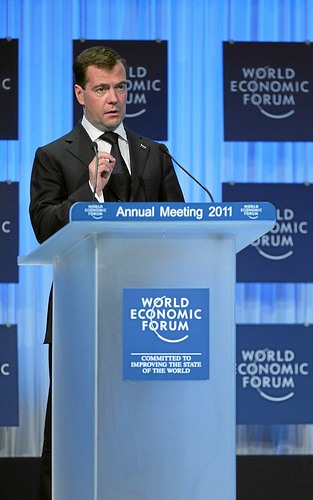
The 2011 annual gathering (Jan 26-30) of the World Economic Forum (WEF), which brings together hundreds of business, political, and finance movers & shakers from around the world, began today in Davos, Switzerland, a renowned winter ski resort for the wealthy and connected.
Trade, global economic competition, job growth, the Federal deficit, spending cuts, taxes, infrastructure investments and technology innovation were the focus of President Obama’s annual State of the Union address to a newly divided Congress last night.
Well, I was wrong, The U.S. and South Korea did manage to get a Free Trade Agreement signed last month. This one, of course, replaces the FTA signed by President Bush in 2007. This deal is very similar to that one except it is better for the auto industry and worse for the meat industry. […]
Another year has sped by with more change and economic uncertainty throughout the global markets. From a journalist’s viewpoint, 2010 was filled with some of the most dynamic and complex economic trends and global market events possible. For instance, the Euro zone debt crisis, the global currency war, coverage of the international currency war – announced by Brazilian Finance Minister and precipitated by Ben Bernanke’s quantitative easing monetarist policy – the perils of high-frequency trading, and the burdensome economic impact of two-front warfare on the domestic agenda are just a few issues that led the Global Markets through a year of risk, volatility, turmoil and uncertainty.
President Obama appointed Bill Daley as White House Chief of Staff this week. I see this as a very positive development from a trade perspective as he has a history of being pro business and pro trade. I am hoping this will mean a new pushed on trade issues that have been all but ignored […]
Ron Kirk, former Mayor of the City of Dallas and presently the Obama administration’s US Trade Representative filed suit against China with the World Trade Organization (WTO) this week, siding with the powerful United Steelworkers union, accusing Beijing of illegally subsidizing the production of wind power equipment which is an anti-competitive practice under WTO rules and harmful to American workers.
According to UPI and NYTs reports about WikiLeaks diplomatic cables, ‘when the European Parliament ordered a halt in February to an American government program to monitor international banking transactions for terrorist activity, the US administration was blindsided by the rebuke from among our closest allies in continental Europe. “Paranoia runs deep especially about US intelligence […]
As financial markets shuddered and then nearly imploded in 2008, the Federal Reserve opened its vault to the corporate world — both domestic and foreign — on a scope much wider and deeper than previously disclosed.
A serious trust has been breached on two levels. First, by WikiLeaks so that nary a foreign contact will wish ever to speak, or at least speak with candor, to even the lowliest Foreign Service personnel. But second, also by the notion, and the threat to life and limb, that we use our Foreign Service personnel as low-cost spies.
Paraphrase of NYTs Helene Cooper’s 26 Nov 2010 article: A fundamental tenet of foreign affairs doctrine holds that sovereign nations will always define and act in their own national interests, and will rarely against their own interests. Somebody needs to tell that to the United States when it comes to China, many foreign policy experts say. A key part of America’s relationship with China now turns on a question that is, at its heart, an interminable conundrum: How to get Beijing to do what its leaders don’t believe are good for their country, but will benefit ours? From economics to climate change to currency to Iran and finally culminating with North Korea last week, America has sought to push, prod and cajole China, to little or no avail.
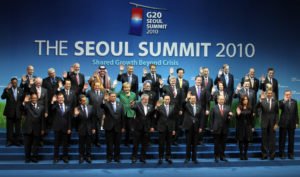
G-20 world leaders meeting in Seoul, South Korea, concluded the summit late Friday by issuing a joint communiqué, with no specifics, agreeing only in general terms to curb “persistently large imbalances” in saving and spending. But deep divisions, especially over the US-China currency dispute, left G-20 officials negotiating all night to draft a watered-down statement for the leaders to endorse, keeping alive a dispute that raises fears of a global trade & currency war, and fears of rising protectionism among nations.
Last June President Obama stood on the world stage and said he would have the U.S.-South Korea Free Trade Agreement sign on this trip to Asia. Last week, he against stood on the world stage on said trip to Asia and was forced to admit failure on this issue. The global trade world was hopeful […]