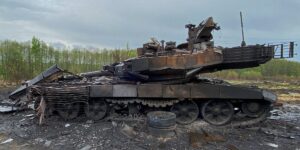
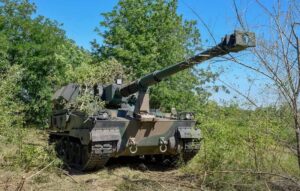
While there are a lot of conflicting reports on the front lines in Ukraine, it seems as if the need for added military support in Eastern Ukraine is needed now more than ever. The debate on sending European Leopard 2 tanks to Ukraine was finally met with a coordinated response to Ukraine by their Western […]
The recent conflict between Russia and Ukraine was taken by many Central and Eastern European countries as a sign of drastic change in a part of the world that had not experienced such a transformation in a generation. The annexation of Crimea was not met with much of a response beyond limited sanctions in 2014, […]
Active Support for Ukraine has made history for the amount of funds and military equipment that has been given to Ukraine by NATO and other supportive nations. Sanctions against Russia has also made history for the level of restrictions and depth of sanctions against Russia’s Government and those tied to Putin himself. The donated advanced […]
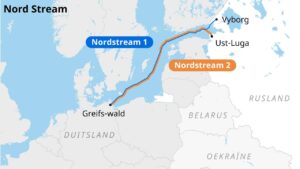
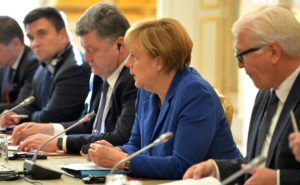
When Angela Merkel took office as Federal Chancellor in 2005, she was more prepared for the challenges on the EU’s eastern border than any other West European head of government. However, Berlin had, already before Merkel’s take over of the chancellorship, sent wrong signals to the new neo-imperial leadership in Moscow by inviting Putin to the Bundestag in 2001 and starting the Nord Stream projects in 2005. Consequential missteps before and after Merkel came to power put German Ostpolitik on the wrong path in the new century. In 2014, there was only a partial correction of the Russia course set by Germany’s 1998-2005 Chancellor Gerhard Schröder. Today, politicians, diplomats and experts in Moscow likely wonder what has gotten into the Germans since the annexation of Crimea: Weren’t Russian special rights in the post-Soviet space an unwritten law of post-Cold War Eastern European geopolitics accepted by Berlin?
With the sudden shock of Covid-19, almost all economic activity locally and globally had ceased after February 2020. Only now towards the end of May 2020 have some countries decided to carefully open up businesses, economies and society in returning to normalcy. Much of the idea of a return to normal is linked to the […]
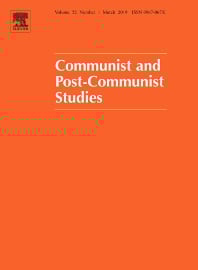
How post-imperial democracies die: A comparison of #WeimarGermany and post-Soviet #Russia. With Steffen Kailitz of the HAIT @TUDresden_DE and @DVPW_Vergleich in @Elsevier‘s “#Communist and Post-Communist Studies” #politics#politicalscience#democratization academia.edu link Researchgate.net link Sciencedirect.com link While socioeconomic crisis – like in Germany after World War I and in Russia after the Cold War – is a necessary […]
Nadia Murad was honoured with a Nobel Prize recently for her work with women and genocide survivors. She is Yazidi from Iraq and survived a kidnapping and rape by ISIS, upon her escape she was able to get her story out to the international community. She became a representative for her community in 2016 and […]
A New Study Documents Meticulously a Wide Range of German Expert Opinion on Ukrainian Affairs and on Their Current Perception in Germany Germany is Western Europe’s demographically and economically most significant country, while Ukraine has, in the post-Soviet period, become a geopolitical pivot state of Eastern Europe as well as the territorially largest […]
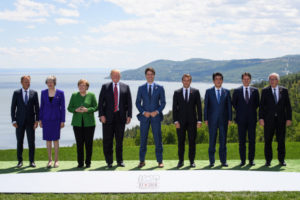
The leaders of the 7-largest global economies gathered on the beautiful bank of Quebec’s St. Lawrence river to acknowledge their commitment to resolve dire global issues according to “our shared values of freedom, democracy, (and) the rule of law.” The world has turned more or less into a shooting venue for a Spaghetti Western film […]
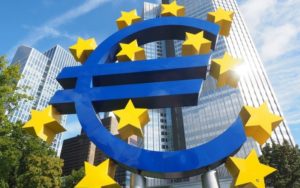
Emmanuel Macron’s ambitious plans to reform eurozone institutions received a further setback when German chancellor Angela Merkel toed her party’s line and rejected some of his bolder proposals when the two met in Berlin last week. Merkel’s stance makes it unlikely that any meaningful structural reform of eurozone institutions will be agreed upon at the […]
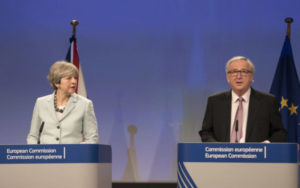
The transition agreement between the UK and EU means that although the UK will officially leave the EU in March 2019, it will still remain in the customs union and single market for another 21 months. The deal was struck after several concessions by the UK, indicating the government’s willingness to sacrifice regaining full sovereignty […]
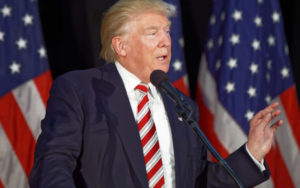
Trump’s State of the Union. Turkey intensifies operations in Syria. Merkel mends her coalition. All this in The Week Ahead. UNITED STATES: Trump’s State of the Union: President Trump will present his State of the Union Address to Congress this Tuesday, following a rough week that included a government shutdown, controversy in Davos, and revelations […]
A passerby helps an old man hit by a car, in Beijing September 9, 2014 (Photo/IC) Joseph Nye of Harvard University first coined the term “soft power” in his 1990 book, Bound to Lead: The Changing Nature of American Power. He explored further the notion of soft power in his 2004 book, Soft Power: The […]
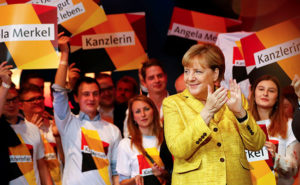
On Sunday, Germany elected Angela Merkel as chancellor for the fourth time, matching the postwar record set by the late Helmut Kohl, who was chancellor of West Germany at the time I was born there. Helmut Kohl has cemented his place in German and European history as the unifier of East and West Germany and one […]
Foreign Policy Blogs is a network of global affairs blogs and a supplement to the Foreign Policy Association’s Great Decisions program. Staffed by professional contributors from the worlds of journalism, academia, business, non-profits and think tanks, the FPB network tracks global developments on Great Decisions 2014 topics, daily. The FPB network is a production of the Foreign Policy Association.